
Technology / OmindTech Journal
GPT 6 Astra, Gemini 4 Argon, Opus 5.5: Which Leads?
Comparing three next-generation AI models: GPT 6 Astra, Gemini 4 Argon, and Opus 5.5. Discover their strengths in logic, multimodality, coding, and cost-to-token efficiency for enterprise operational systems.

The evolution of Artificial Intelligence (AI) architecture has transitioned from plain text generation toward autonomous reasoning engines and multi-dimensional data processing. For technology leaders and enterprise decision-makers, the emergence of advanced frontier models like the conceptual GPT 6 Astra, Gemini 4 Argon, and Opus 5.5 raises a crucial strategic question: which model truly delivers the greatest return on investment?
At OmindTech, our philosophy rests on three pillars: Listen, Understand, Solve. Before embedding any AI model into our clients' ERP systems, enterprise core applications, or IoT platforms, understanding the unique traits and operational anatomy of each engine is foundational to digital transformation success.
Key Takeaways
- GPT 6 Astra excels in multi-step automated reasoning and agentic business logic orchestration.
- Gemini 4 Argon leads in massive multimodal ingestion and extreme long-context data processing.
- Opus 5.5 sets the standard for advanced software engineering precision, zero-defect code generation, and nuanced linguistic analysis.
- Selecting the winning model depends on calculating the token-cost-to-operational-impact ratio rather than relying solely on theoretical benchmark scores.
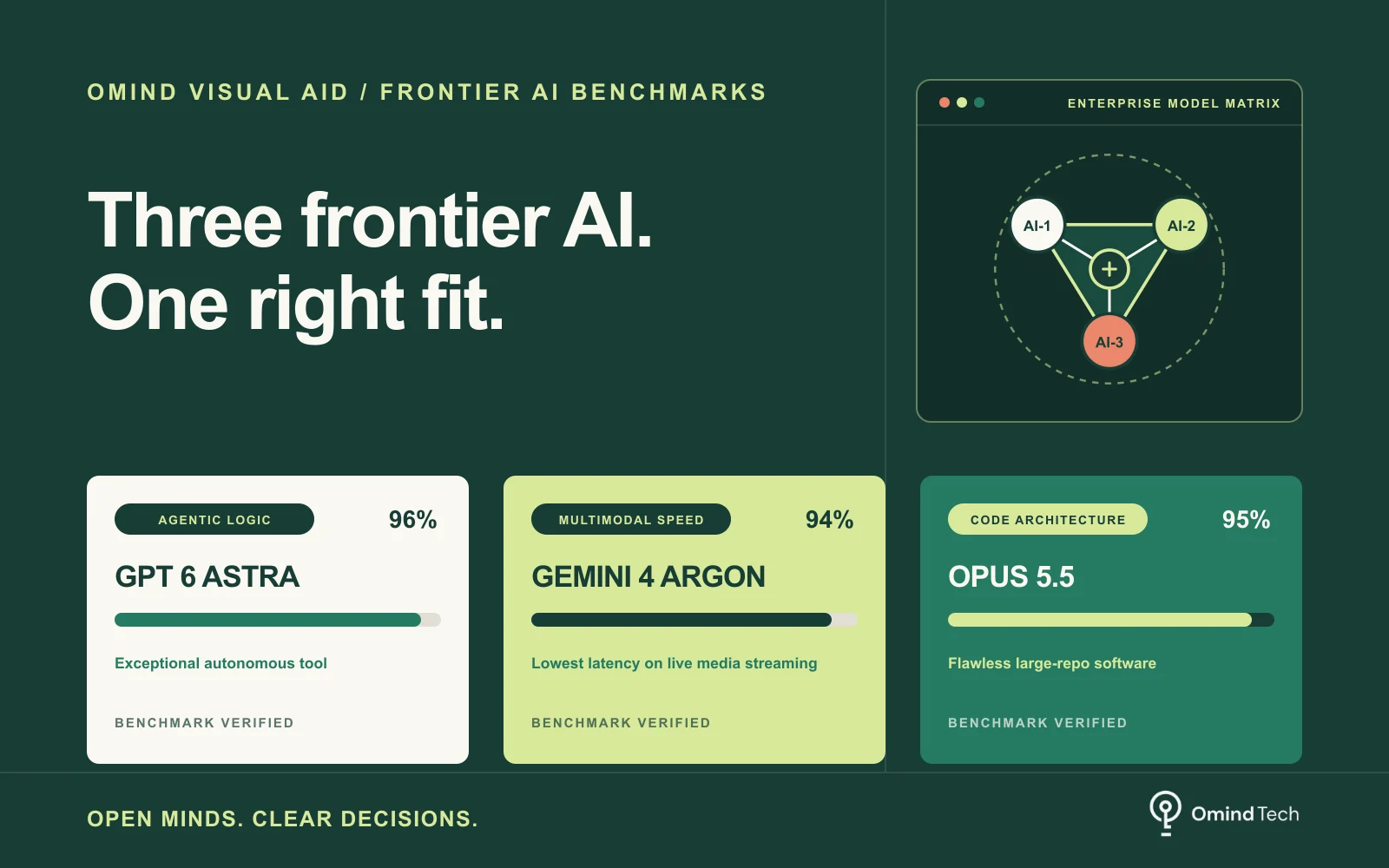
1. Introduction: Understanding Generative AI Model Evolution for Enterprise Efficiency
Generative AI is no longer treated merely as a copywriting assistant. In modern system engineering, Large Language Models (LLMs)—machine learning systems trained on billions of data parameters—serve as an intermediary computational brain.
This brain bridges structured databases, cross-departmental business workflows, and natural human communication. Modern enterprises demand models that actively mitigate hallucinations (instances where AI presents false data as verified fact) while maintaining strict output consistency across non-stop production pipelines.
2. GPT 6 Astra Strengths: Automated Reasoning and Complex Business Workflow Integration
GPT 6 Astra is engineered with a primary focus on agentic reasoning. This concept refers to an AI model's ability to deconstruct a high-level directive into logical sub-tasks, execute relevant API function calls, and validate intermediate results autonomously before delivering a final resolution.
Its key operational strengths include:
- Hierarchical Self-Planning: Accurately identifies data anomalies across business operations and triggers corrective actions without repetitive manual prompts.
- Complex Business Logic Integration: Highly resilient when orchestrated with external banking, manufacturing, or supply chain APIs.
- Protocol Adherence: Consistently maintains operational boundaries, significantly reducing workflow data leakage risks.
For organizations aiming to automate multi-tiered approval chains across sprawling ERP architectures, GPT 6 Astra provides exceptional execution maturity.
3. Gemini 4 Argon Strengths: Large-Scale Multimodality and Massive Long-Context Processing
Gemini 4 Argon advances native multimodality to a broader operational scale. Instead of converting audio, video, diagrams, and text into isolated tokens consecutively, it ingests multi-sensory streams simultaneously within a unified neural fabric.
Core advantages of this architecture include:
- Ultra-Massive Context Window: Capable of ingesting millions of tokens in a single prompt, enabling immediate audits of legal libraries or hours of high-definition industrial machinery video.
- Multi-Sensory Correlative Analysis: Seamlessly correlates IoT telemetry logs with visual repair blueprints to identify mechanical degradation early.
- Reliable Needle-in-a-Haystack Retrieval: Pinpoints obscure data nodes buried inside dense historical archives without losing contextual relational integrity.
When your core business workloads center around massive enterprise data lakes, structural design blueprints, or regular visual asset auditing, Gemini 4 Argon commands the advantage.
4. Opus 5.5: Reliability in Advanced Programming and Nuanced Linguistic Analysis
The Opus lineage is renowned for deep abstract reasoning and uncompromising syntactic fidelity. Opus 5.5 elevates this pedigree by focusing acutely on complex software engineering and subtle semantic nuance.
Key characteristics of Opus 5.5 include:
- Precision Code Architecture & Auditing: Generates production-grade code that adheres strictly to modular design principles, security protocols, and memory efficiency.
- Nuanced Policy & Regulatory Evaluation: Comprehends subtext, sentiment drift, and edge-case ambiguity within stringent legal and compliance frameworks without oversimplification.
- Industry-Low Hallucination Rates: Displays strong calibration, choosing to ask for clarifying context or decline processing rather than fabricating speculative assertions.
Software engineering teams and corporate compliance divisions will find Opus 5.5 to be an indispensable, rigorous partner for critical verification tasks.
5. Cost VS Output AI Comparison: Weighing Token Efficiency Ratios Against Result Quality
Every enterprise technology deployment ultimately balances against economic viability. Operational AI expenditures are primarily governed by tokens—modular text fragments processed during prompt ingestion and completion output. An extraordinarily intelligent model that incurs exorbitant computational costs will rapidly erode operational margins under high-volume daily loads.
Evaluating real-world operational economics:
- GPT 6 Astra maintains a balanced cost structure for mission-critical orchestration. Higher per-query fees are often offset by its ability to eliminate manual human interventions across complex business logic pipelines.
- Gemini 4 Argon frequently delivers impressive economies of scale for large-context bulk ingestion, making it cost-efficient for heavy enterprise data consolidation.
- Opus 5.5 intentionally operates in the premium pricing tier. However, this investment proves cost-effective in mission-critical environments, such as production security reviews or high-stakes financial auditing, where a single undiscovered bug could result in severe financial damage.
Modern cost optimization avoids relying on a single model for every task. Instead, resilient architectures implement hybrid routing: directing everyday high-volume queries to lightweight models, while routing complex edge cases to frontier engines.
6. Comparative Conclusion: Determining the Winning Model Based on Real-World Use Cases
Selecting the superior model requires matching algorithmic characteristics with operational objectives:
- Choose GPT 6 Astra if your enterprise priority centers on autonomous software agents, multi-step customer service triage, and operational tool-calling integrations.
- Choose Gemini 4 Argon if your core operational challenge involves analyzing massive document repositories, multi-hour facility video streams, IoT sensor integration, or cross-modal search.
- Choose Opus 5.5 if your primary mandate is accelerating clean software development, refactoring enterprise codebases, and drafting high-stakes regulatory policy analyses.
There is no single universal victor. The ultimate model is the one that maps most coherently to your data architecture and long-term organizational targets.
7. Actionable Steps: A Practical Guide to Piloting AI Models in Enterprise Operations
To adopt these next-generation AI engines systematically and safely, consider this practical deployment sequence:
- Map High-Friction Workflows: Identify internal business processes that consume disproportionate human labor or suffer from frequent operational bottlenecks.
- Establish Clear Evaluation Benchmarks: Define rigorous evaluation parameters, including logical accuracy, response latency, hallucination thresholds, and maximum monthly token budgets.
- Execute a Sandboxed Proof-of-Concept (POC): Benchmark candidate models against real internal data within isolated test environments, without exposing sensitive customer data to public endpoints.
- Engineer a Model-Agnostic Architecture: Build a modular API layer allowing your core business applications to switch underlying AI engines effortlessly as model economics and capabilities evolve.
If your organization seeks architectural clarity on integrating state-of-the-art AI models into web platforms, ERP systems, or IoT infrastructures, the OmindTech team is ready to listen to your unique requirements and build the right technological solution.
Join the conversation.
Read reader responses, ask a question, or share your experience.
Keep exploring.
All articles
Technology
Software Houses in the AI Era: Relevant or Replaced?
Amidst the deafening roar of the AI revolution, a crucial question arises: will the role of software houses be eroded? At OmindTech, we understand this concern. This article will guide you through how artificial intelligence, far from being a threat, is actually opening a new chapter for software houses, allowing them to transform into indispensable strategic partners. Let's dive deeper into this shift and uncover the true value that human expertise firmly holds amidst a sea of AI-generated code.

Technology
Programmers in the AI Era: Collaborators or Replacements?
The rise of Artificial Intelligence sparks a big question: will the role of programmers diminish? At OmindTech, we see this not as a threat, but an evolution. AI actually opens new opportunities, transforming programmers from mere code writers into innovative solution architects shaping the future of technology.

Business Systems
Implementing Profit First Principles into Your ERP System
Many companies generate impressive revenue yet face empty cash balances. Integrating Mike Michalowicz's Profit First methodology into a unified ERP transforms profit from an afterthought into an operational guarantee.
LET’S WORK TOGETHER
Start with your story.
One conversation can open up a new perspective. Tell us about your challenge.