
Business Systems / OmindTech Journal
Implementing Profit First Principles into Your ERP System
Many companies generate impressive revenue yet face empty cash balances. Integrating Mike Michalowicz's Profit First methodology into a unified ERP transforms profit from an afterthought into an operational guarantee.

Many business founders and leadership teams find themselves trapped in an illusion of top-line growth. Sales charts point upward, orders flood in, yet the operational bank balance at month-end remains mysteriously depleted. This issue is not new. In his classic book Profit First, Mike Michalowicz points out a pervasive habit among business operators: managing liquidity through "checkbook accounting." When bank balances look plentiful, leaders instinctively feel compelled to spend on expansion, upgraded offices, or non-essential vendor contracts.
Key Takeaways:
- Traditional accounting treats profit as a fragile leftover, while the Profit First framework prioritizes profit before allocating any operational spending.
- Executing multi-account cash splits manually causes high reconciliation friction and administrative strain as transaction volume expands.
- Embedding Profit First logic directly into an integrated ERP system enforces allocation rules automatically without burdensome daily manual bank transfers.
- Unified business systems apply automated operational guardrails, stopping department purchase requisitions if real operational cash is insufficient.
Reversing the Conventional Financial Formula
For centuries, conventional accounting has taught a standard equation: Sales - Expenses = Profit. Mathematically and for general accounting reports, this is correct. Behaviorally, however, it turns profit into an afterthought—whatever happens to remain after operating expenses have taken their share.
The core thesis of Profit First radically flips this relationship: Sales - Profit = Expenses. Michalowicz draws upon Parkinson's Law, which states that demand for a resource expands to match the supply provided. When an organization's cash sits combined in a single main bank account, staff and leaders naturally spend it down to its limits. By reserving profits upfront, operational spend is intentionally constrained, driving real efficiency throughout the organization.
The Core Logic of Five Cash Accounts
To apply this discipline, the original methodology prescribes setting up five distinct bank accounts:
- Income: The collection hub for all incoming customer receivables before any funds are moved.
- Profit: A locked reserve establishing financial resilience and funding shareholder distributions.
- Owner's Pay: Formal compensation for the active leadership team, distinct from ownership dividends.
- Tax: Dedicated reserves for tax liabilities to prevent year-end liquidity surprises.
- Operating Expenses (OpEx): The actual pool permissible for daily operations, vendor invoices, payroll, and facility rent.
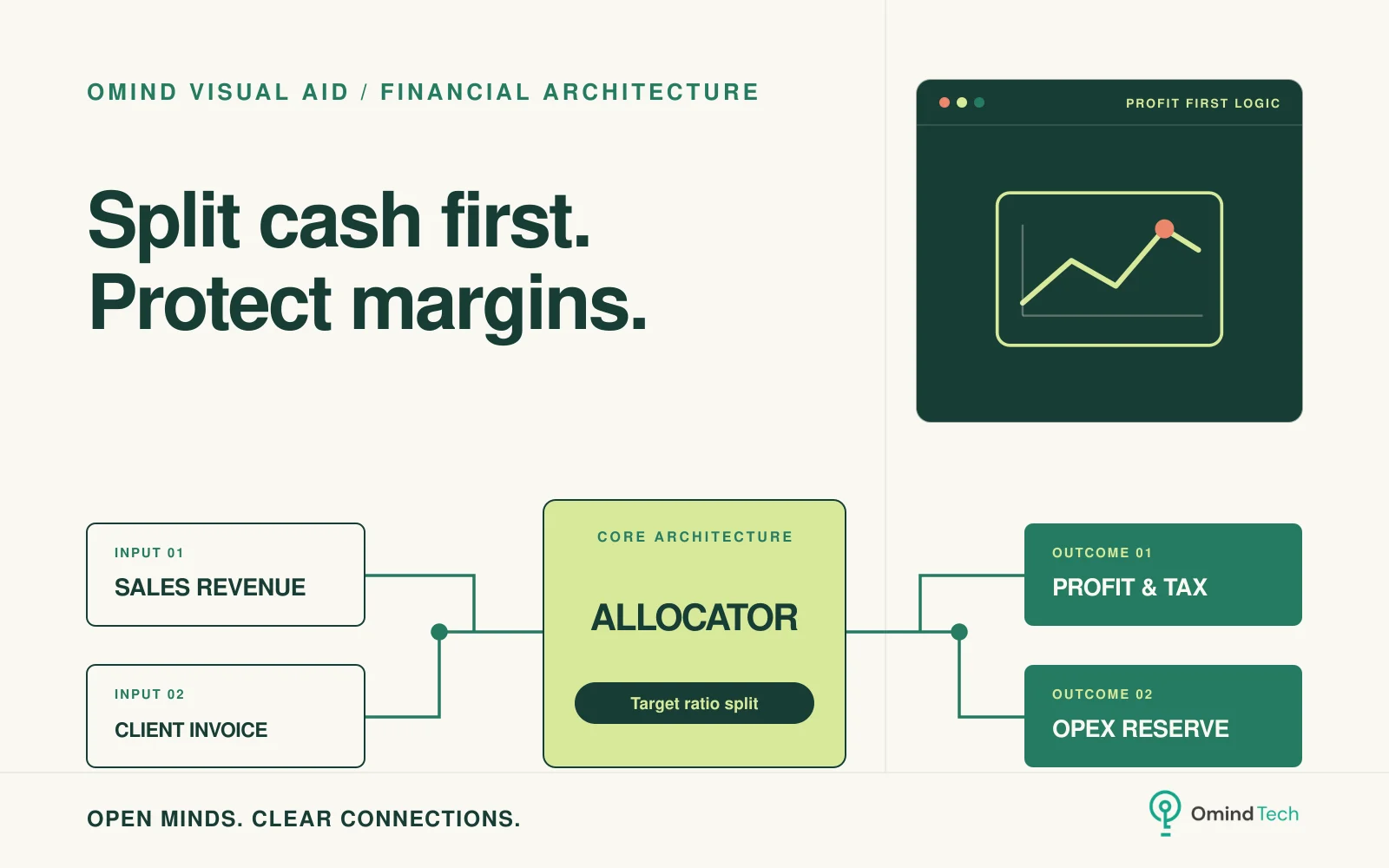
On regular cadence—typically twice a month—funds sitting in the Income account are distributed across the other four accounts according to predefined ratios known as the Target Allocation Percentage (TAP).
The Friction of Manual Execution at Scale
Setting up five physical bank accounts works fine for small solo enterprises handling moderate transaction volumes. But as a business scales to hundreds of daily orders and substantial recurring capital flows, manual execution hits severe operational roadblocks.
Accounting personnel are forced to log into banking portals, execute repetitive wire transfers, and manually reconcile internal transfer journals across distinct general ledgers. The risk of human oversight is immense: transfer dates are missed due to staff absences, percentages are miscalculated, or managers casually "borrow" from the profit bucket when an immediate supplier invoice looms without governance controls.
Automating Allocation into an Integrated Business System (ERP)
The answer to sustaining Profit First discipline without bureaucratic drag is embedding the allocation rules directly into an Enterprise Resource Planning (ERP) platform. At OmindTech, we routinely see that automating financial workflows is what makes financial discipline enduring rather than dependent on memory or willpower.
Rather than shuffling cash across five physical banking accounts—which incurs ongoing administrative maintenance fees—the ERP can be configured with virtual sub-ledgers tied to central banking lines.
Whenever the Accounts Receivable module processes an invoice settlement, the integrated system's business rules engine triggers automatic distribution:
- Inflow is parsed instantaneously: for example, 10% routes to the virtual Profit Reserve, 15% to Tax Reserve, 20% to Owner's Compensation, and the remaining 55% to the active Operational Pool.
- This allocation executes at the sub-ledger level alongside automatic bank reconciliation, removing the chore of manual weekly banking transfers.
- Leadership achieves absolute certainty that tax and reserve funds cannot be accidentally consumed by departmental purchases.
Enforcing Operational Guardrails in Procurement
The most transformative advantage of this architectural setup is proactive spending control. In typical corporate setups, department managers approve Purchase Orders (POs) simply by looking at their annual paper budget, completely detached from whether real cash liquidity exists to settle the invoice when due.
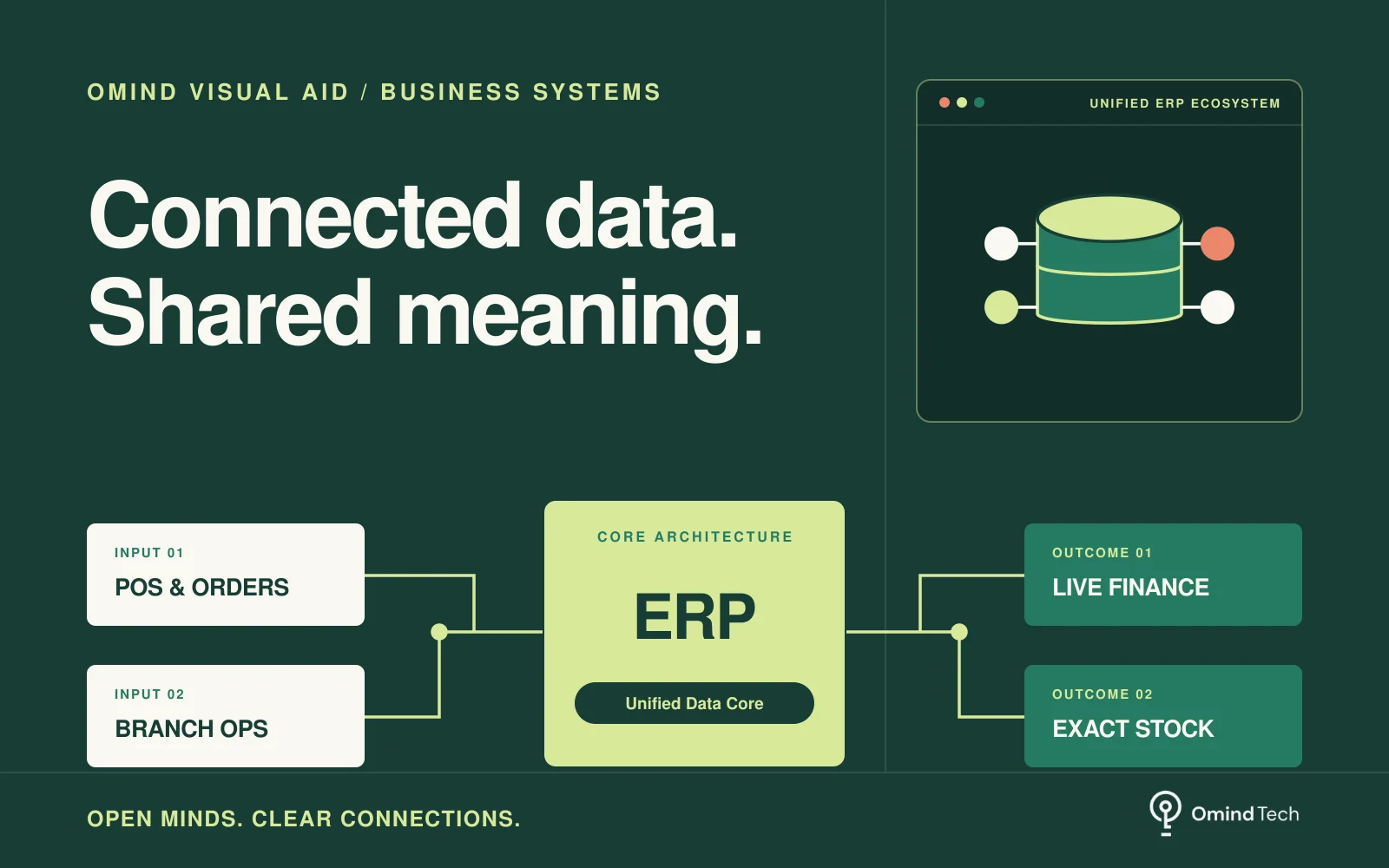
Inside an ERP configured with Profit First principles, the procurement workflow is tied directly to the real-time OpEx cash balance:
- Automated Overspend Prevention: The system systematically declines or holds new purchase orders whenever the order total exceeds the uncommitted cash available within the Operating Expenses sub-ledger, even if the department's annual budget spreadsheet displays a surplus.
- Transparent Escalation Rules: If an urgent purchase must proceed, the software triggers an executive override workflow that logs a strict audit trail explaining precisely why and how the operational boundary was breached.
This single mechanism drives division heads to operate lean and negotiate better commercial terms, rather than constantly petitioning for budget increases that erode overall margins.
Real-Time Monitoring Through Centralized Dashboards
A unified platform delivers real-time fiscal clarity. Executive teams no longer need to wait for retrospective income statements two weeks after month-end to understand true organizational health.
Dynamic analytical dashboards display a live contrast between the company's Current Allocation Percentage (CAP)—the present state of cash distribution—and the executive Target Allocation Percentage (TAP). If operating expenses creep above designated threshold percentages, the dashboard triggers automated early warnings. Management can renegotiate vendor terms or calibrate pricing strategies proactively before liquidity runs thin.
Practical Steps to Begin Your Implementation
Transforming financial operations requires a step-by-step approach. If your organization is ready to automate this methodology into your enterprise technology stack, here is how to begin:
- Audit 12 Months of Cash History: Conduct a thorough review of historical cash flow to determine your actual Current Allocation Percentage (CAP) across operations, compensation, and taxes.
- Establish Realistic Allocation Targets (TAP): Avoid slashing operating allowances overnight. If operations currently consume 85% of revenue, establish an initial target of 83% for the upcoming quarter by redirecting 2% directly to profit reserves.
- Map Ledger Accounts in Your Financial Architecture: Structure your Chart of Accounts inside your ERP to create protected virtual sub-ledgers mirroring the Profit First framework.
- Configure Automated Allocation Rules: Implement automatic percentage distribution rules across accounts receivable receipts, and tie procurement approval workflows directly to the live OpEx sub-ledger balance.
- Review and Calibrate Quarterly: Revisit your percentages every quarter, incrementally stepping up your profit allocations as operations become leaner and more resilient.
Integrated software exists not merely to document financial history, but to systematically enforce sound financial behavior. By combining the Profit First philosophy with the precision of an ERP system, profitability ceases to be a hope for the fiscal year-end—it becomes a daily operational reality.
Join the conversation.
Read reader responses, ask a question, or share your experience.
Keep exploring.
All articles
Business systems
Replacing CS with AI: Cost Efficiency or AI Slop Trap?
Many executives are tempted to slash support payroll for instant AI efficiency, only to leave clients alienated by hallucinated answers. Here is how to architect an enterprise custom AI agent connected to ERP data with a human-in-the-loop framework that protects brand reputation.

Business Systems
Orkesa.id: Business Transformation with OmindTech's Integrated System
Imagine an orchestra where every instrument plays in perfect harmony, creating a beautiful symphony. That's how Orkesa.id works for your business. At OmindTech, we understand that managing various operational aspects – from finance to customer interactions – can be a significant challenge. Orkesa.id emerges as a digital conductor, unifying ERP, CRM, sales automation, and even chatbots, transforming chaos into a symphony of efficiency and growth.

Business Systems
Guide to Choosing Digital Approval Workflows: User Needs
Ever felt bogged down by piles of paperwork or endless email chains just to get a single approval? For many companies, complex approval processes are a major productivity bottleneck. This article will guide you on how to choose and implement the right digital approval workflow, starting from the most important voice: your users' needs.
LET’S WORK TOGETHER
Start with your story.
One conversation can open up a new perspective. Tell us about your challenge.