
Business systems / OmindTech Journal
Replacing CS with AI: Cost Efficiency or AI Slop Trap?
Many executives are tempted to slash support payroll for instant AI efficiency, only to leave clients alienated by hallucinated answers. Here is how to architect an enterprise custom AI agent connected to ERP data with a human-in-the-loop framework that protects brand reputation.

Cost-cutting proposals sound intensely attractive inside boardrooms. Simply deploy a generic Large Language Model (LLM), shut down conventional support ticket queues, and let an automated system answer client inquiries around the clock without demanding annual bonuses or paid time off. Yet, this reckless pursuit of immediate savings frequently triggers a costly reputational crisis.
Businesses rushing to replace their customer support teams with generic, off-the-shelf chatbots often face severe customer backlash. Instead of swift issue resolution, buyers are met with wordy non-answers, fabricated promises invented by ungrounded algorithms, or what the industry now calls AI slop—low-quality automated filler that fails to resolve actual problems.
Key Takeaways
- AI Slop Destroys Retention: Swapping support personnel for cheap, ungrounded bots produces hallucinated statements that erode client trust.
- B2B Context Is Paramount: High-stakes customer service requires direct real-time data access to ERP and CRM engines, not static FAQ summaries.
- Custom Agent Architecture: Modern automation hinges on Retrieval-Augmented Generation (RAG) coupled with rigid semantic boundaries.
- The Human-in-the-Loop Principle: Sustainable efficiency emerges when AI absorbs roughly 70% of repetitive tier-1 tasks, escalating critical edge cases to human specialists.
The Support Automation Dilemma: Trimming Budgets vs. Brand Damage from AI Slop
The term AI slop refers to machine-generated outputs that appear grammatically sound on the surface but are hollow, repetitive, or factually incorrect. In customer support, AI slop manifests when a bot answers a delayed freight delivery ticket with a four-paragraph poetic apology without checking fleet telemetry or dispatch logs.
For simple direct-to-consumer retail, such robotic platitudes might only cause mild irritation. In the enterprise and B2B realm, the stakes are exponentially higher. When a corporate procurement director asks about the fulfillment status of an essential raw material order, they demand verified inventory realities, not synthetic sympathy crafted by a language model.
When an untrained bot commits to unapproved discounts or confirms stock availability for backordered supplies, the business absorbs direct commercial liability. Sacrificing long-term client retention just to lower short-term payroll costs is a dangerous financial illusion.
Why Off-the-Shelf Bots Fail Complex B2B Customer Service Contexts
Most turnkey software tools marketed as AI customer service packages operate merely as thin wrappers over generic generative model APIs. These public models are trained to predict the next statistically probable word, not to audit your company's operational records.
Three foundational limitations cause these generic products to stumble in mission-critical environments:
- Zero Transactional Awareness: Generic models know nothing about individual client purchase histories, bespoke Service Level Agreements (SLAs), or customized credit terms documented in your ledger.
- Static Knowledge Bottlenecks: Off-the-shelf bots typically scan uploaded PDF sheets or static help centers. The moment warehouse inventory updates on your shipping floor, the bot's frame of reference becomes obsolete.
- Inability to Execute Actions: Conventional chatbots are built merely to generate conversational prose. They lack the system hooks to execute tangible actions such as adjusting a CRM status, halting a fulfillment batch, or issuing an enterprise credit memo.
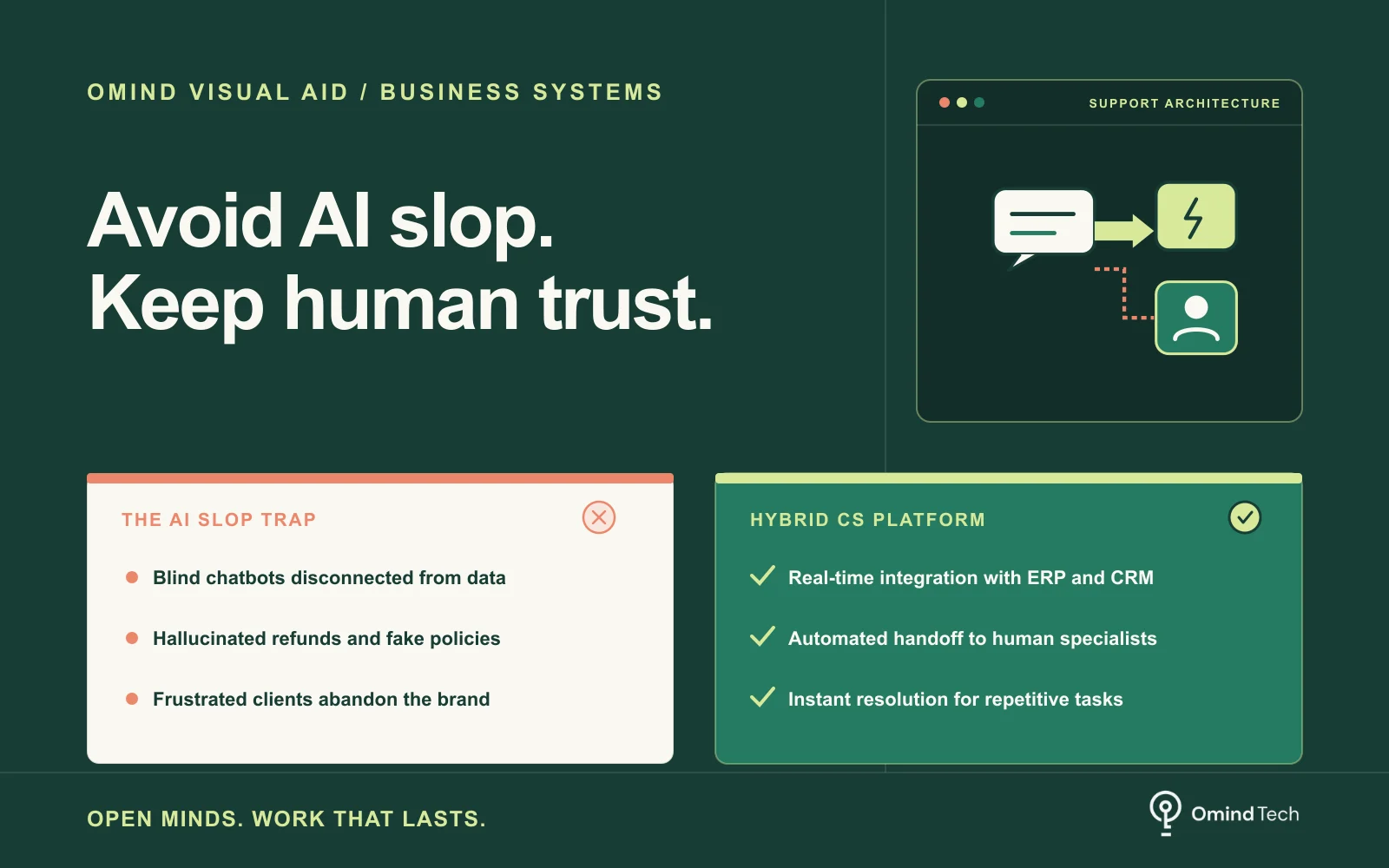
Within the enterprise landscape, businesses must move away from surface-level chatbots and adopt custom AI agents directly tethered to verifiable operational data.
Custom AI Agent Architecture: Securing LLMs with Verified Knowledge and Internal ERPs
To entrust artificial intelligence with mission-critical communication, the system cannot function in isolation. At OmindTech, we engineer custom enterprise chatbots and agents utilizing a modular architecture that anchors language models directly to an organization's single source of truth.
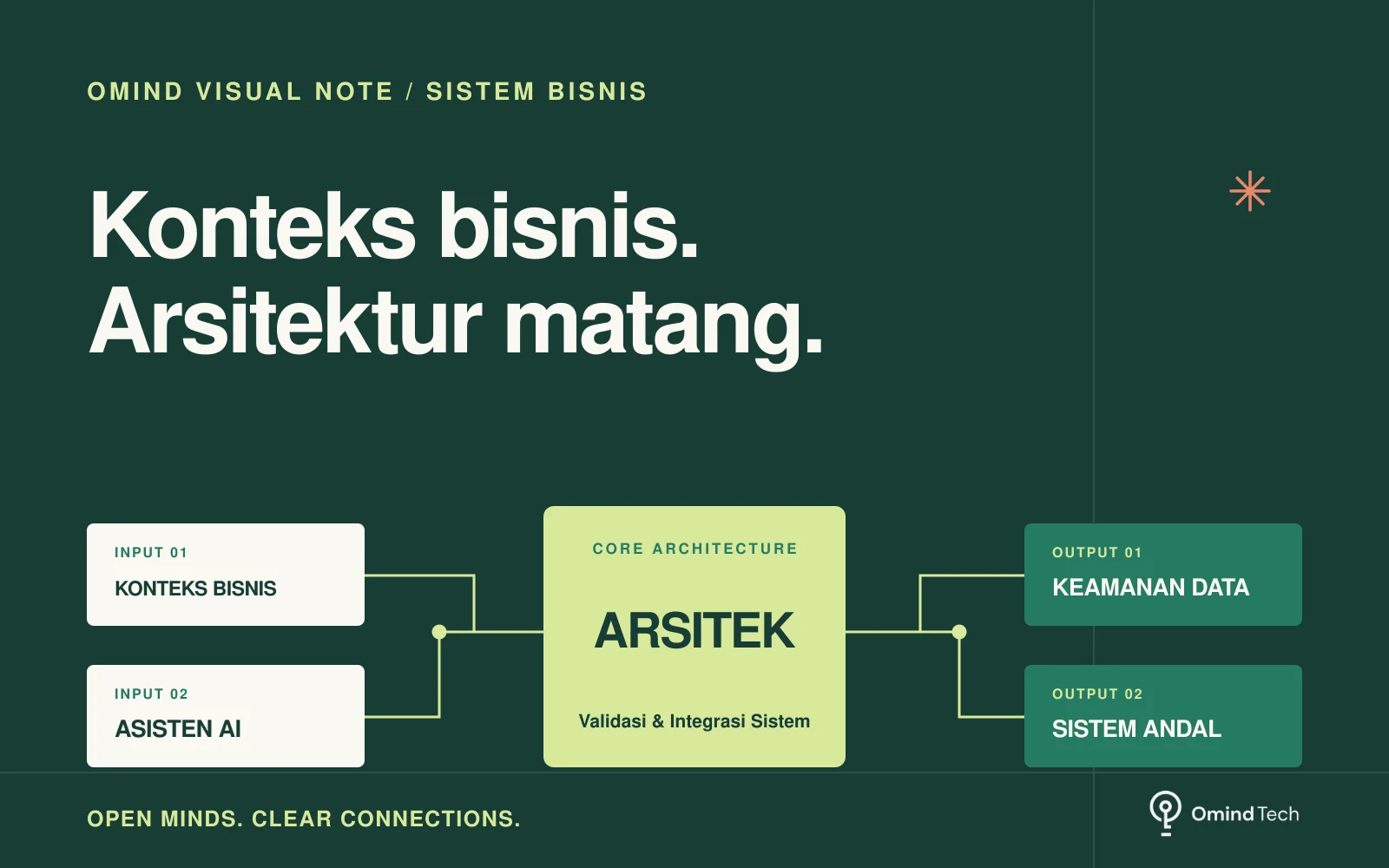
This robust agentic architecture stands on three architectural pillars:
1. Verified Retrieval-Augmented Generation (RAG)
Rather than undertaking costly model fine-tuning every time an internal policy changes, the platform utilizes RAG workflows. When a query arrives, semantic retrieval engines parse verified standard operating procedures, technical manuals, and product catalogs to provide factual citations that the LLM must adhere to strictly.
2. Secure API Connectors into Enterprise ERP and CRM Data
Utilizing tool-calling capabilities, the custom agent holds programmatic access to operational backbones such as custom ERP or CRM databases. When a procurement officer requests an order update, the agent triggers an authenticated API query, captures live status parameters, and formulates a concise response backed by real-time facts.
3. Semantic Guardrails and Hallucination Defenses
The system incorporates deterministic guardrails that deliberately block speculative replies outside corporate jurisdiction. If requested data points do not exist within the enterprise database, the agent transparently acknowledges the limitation rather than hallucinating an answer.
Through professional enterprise AI development, automation shifts from a liability into a resilient operational asset.
The OmindTech Framework: Ensuring Support Accuracy Through Human-in-the-Loop Design
No matter how advanced software becomes, technology is never intended to strip human judgment completely out of high-value business relationships. Our foundational methodology at OmindTech is built upon three steps: Listen, Understand, Solve. We listen to your workflow friction, understand client touchpoints, and construct functional software that solves root business bottlenecks.
When deploying enterprise support systems, we implement a Human-in-the-Loop (HITL) framework that balances machine speed with human discretion across two operating tiers:
- Tier-1 Autonomous Triage: The AI agent autonomously resolves 60% to 80% of repetitive operational questions—including logistics tracking, inventory lookups, and baseline technical documentation—with zero response delay.
- Tier-2 Context-Rich Escalation: When the system identifies customer frustration, high-value contract negotiations, or database discrepancy flags, the session transfers to a human specialist. The AI supplies an instant brief containing conversational context and suggested action paths, allowing staff to resolve the issue without forcing clients to restate their problem.
- Continuous Telemetry & Feedback: Each time a human operator modifies an AI-drafted reply or overrides an action, the system logs the corrective pattern to continuously refine prompt templates and retrieval precision.
Through this hybrid dynamic, tangible B2B efficiency is realized. Operational overhead falls dramatically while maintaining the nuance and trust that clients expect.
Practical Steps to Evaluate Support Automation for Your Enterprise
Before signing third-party automation software licenses or reallocating customer support personnel, work through this practical evaluation checklist:
- Audit Support Interaction History: Categorize your previous 1,000 support interactions into two pools: structured data queries (stock queries, shipping dates, invoice lookups) versus nuanced matters demanding empathy and policy exceptions.
- Assess System API Readiness: Ensure your internal catalogs, fulfillment tracking, and account directories live inside clean databases accessible via documented APIs.
- Deploy as an Internal Co-Pilot First: Prior to exposing an automated agent directly to external customers, let your human team use the tool internally to test response accuracy and evaluate system speed.
- Partner with Custom Software Specialists: Avoid rigid plug-and-play platforms that retain proprietary control over your customer interactions and integration architecture.
Customer service automation is never about shrinking headcounts down to zero; it is about liberating skilled team members from repetitive administrative drudgery. If you are ready to design a custom, accurate AI agent integrated directly with your internal ERP systems, contact the OmindTech team to build an enduring solution.
Join the conversation.
Read reader responses, ask a question, or share your experience.
Keep exploring.
All articles
Business Systems
Implementing Profit First Principles into Your ERP System
Many companies generate impressive revenue yet face empty cash balances. Integrating Mike Michalowicz's Profit First methodology into a unified ERP transforms profit from an afterthought into an operational guarantee.

Business Systems
Orkesa.id: Business Transformation with OmindTech's Integrated System
Imagine an orchestra where every instrument plays in perfect harmony, creating a beautiful symphony. That's how Orkesa.id works for your business. At OmindTech, we understand that managing various operational aspects – from finance to customer interactions – can be a significant challenge. Orkesa.id emerges as a digital conductor, unifying ERP, CRM, sales automation, and even chatbots, transforming chaos into a symphony of efficiency and growth.

Business Systems
Guide to Choosing Digital Approval Workflows: User Needs
Ever felt bogged down by piles of paperwork or endless email chains just to get a single approval? For many companies, complex approval processes are a major productivity bottleneck. This article will guide you on how to choose and implement the right digital approval workflow, starting from the most important voice: your users' needs.
LET’S WORK TOGETHER
Start with your story.
One conversation can open up a new perspective. Tell us about your challenge.