
Technology / OmindTech Journal
Programmers in the AI Era: Collaborators or Replacements?
The rise of Artificial Intelligence sparks a big question: will the role of programmers diminish? At OmindTech, we see this not as a threat, but an evolution. AI actually opens new opportunities, transforming programmers from mere code writers into innovative solution architects shaping the future of technology.

Will programmers still be relevant in the rapidly advancing era of Artificial Intelligence (AI)? This question often arises in business and technology discussions. Many worry that AI will replace human roles, including programmers. However, we at OmindTech hold a different view. We believe that AI is not the end of the programmer's role, but rather the beginning of an exciting evolution.
Key Takeaways
- AI acts as a collaborator, enhancing programmer efficiency, not a replacement.
- The programmer's role evolves from code writer to solution architect and complex problem solver.
- Essential skills in the AI era include AI/ML fundamentals, critical thinking, system design, and communication.
- "Vibe coding" will increase as AI removes repetitive tasks, allowing for creative focus.
- IT degree programs remain strategic in preparing talent with future skills.
- Proactive adaptation and continuous learning are key to relevance.
AI as a Collaborator, Not a Competitor
The fear of AI taking over programmer jobs often stems from a misunderstanding. AI, in the context of software development, is more accurately described as an advanced assistant. It is designed to perform repetitive, tedious, and time-consuming tasks.
The most evident example is the automation of boilerplate code generation—standard code segments that must be written repeatedly for every project. AI can generate this basic code quickly and accurately, freeing programmers from this burden. AI can also provide initial debugging suggestions, helping identify potential errors in code before humans delve deeper.
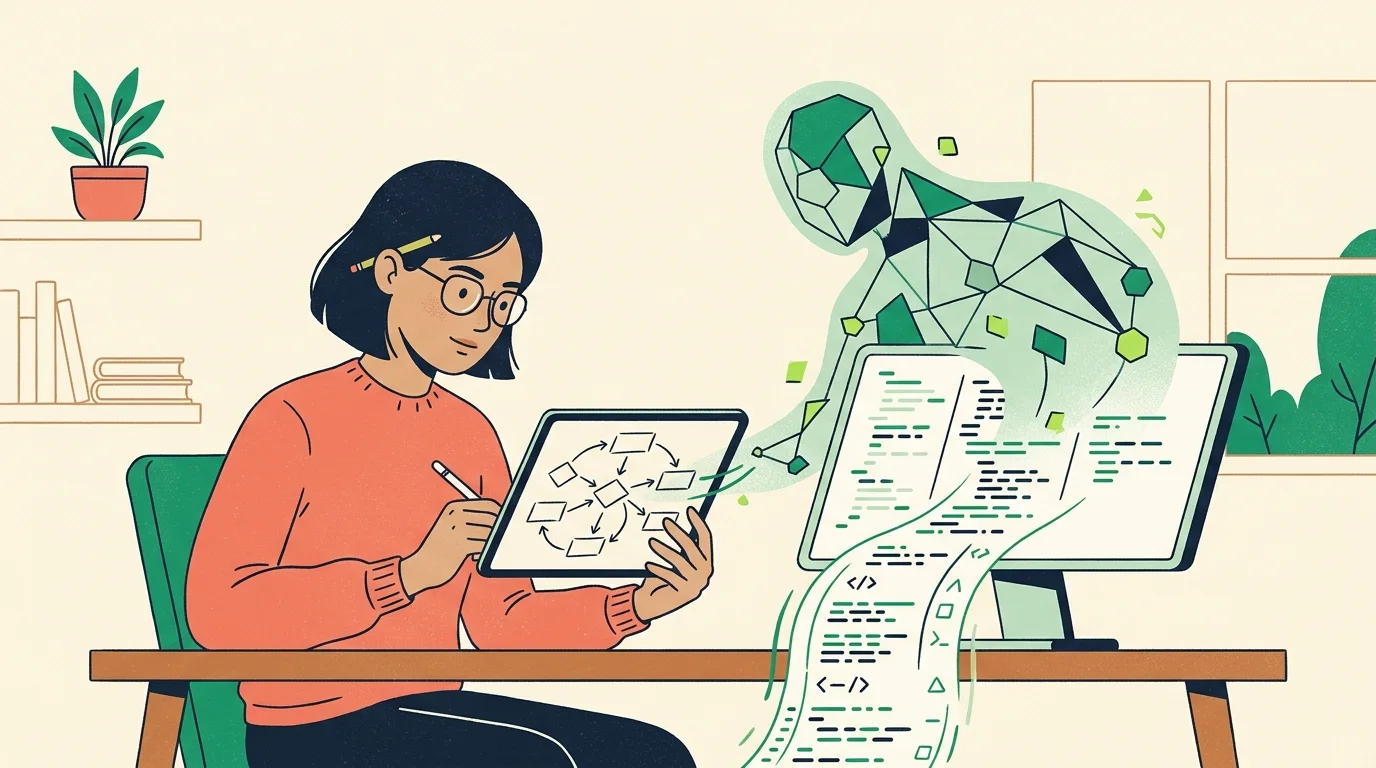 AI assists programmers with repetitive tasks, enabling focus on design and complex problem-solving.
With AI's help, a programmer can be significantly more productive. They no longer spend hours on repetitive work but can instead focus on aspects that require critical thinking, creativity, and a deep understanding of the business problems to be solved. AI becomes an empowering tool, not a substitute.
The Evolution of the Programmer's Role
A programmer's role is no longer limited to merely translating logic into lines of code. Now, the focus shifts to a more strategic domain. The future programmer is a reliable system designer, a visionary solution architect, and an excellent complex problem solver. They are the bridge between business needs and technological solutions.
This includes the ability to integrate and implement AI-powered tools into larger systems. A programmer must understand how AI can enhance application functionality, how data is processed, and how to ensure ethics and security in its use. This role demands a holistic understanding of software architecture and business.
Essential Programmer Skills in the AI Era
To remain relevant, programmers must develop a set of skills that go beyond pure coding ability.
- Fundamental Understanding of AI/Machine Learning: No need to be an AI expert, but understanding basic concepts like how machine learning models work, when to use them, and their limitations is crucial.
- Critical Thinking and Problem-Solving: This is the core of a programmer's job. AI can provide answers, but humans formulate the questions and understand the context of the problem.
- System Design and Architecture Skills: Designing scalable, secure, and efficient systems is a skill irreplaceable by AI.
- Effective Communication: Being able to translate vague business requirements into clear technical specifications and explain complex solutions to non-technical stakeholders.
- Willingness for Continuous Learning: Technology changes very rapidly. The readiness to continuously learn new technologies and adapt is key.
The Future of 'Vibe Coding' and IT Degree Programs
The term "vibe coding" refers to an enjoyable and satisfying coding experience, where programmers can focus on the creative and challenging aspects. AI has significant potential to enhance this "vibe coding." With AI handling grunt work such as basic code writing or trivial bug hunting, programmers can dedicate their energy to innovation, creating unique features, and solving complex logical puzzles.
This means the programming profession can become more engaging and motivating. Higher education institutions, especially IT degree programs, play a crucial role in preparing this talent. Curricula must shift from merely teaching programming syntax to instructing system design concepts, AI ethics, critical thinking, and interdisciplinary collaboration.
 IT education prepares talent for creative and innovative "vibe coding" supported by AI.
The future of IT talent is very bright, provided education can adapt.
Examples of AI Application in Software Development
We observe how AI is already widely used to accelerate the software development lifecycle in various ways.
- Automated Code Analysis: AI can review millions of lines of code to find security vulnerabilities, potential bugs, or violations of coding standards, much faster than manual review.
- Automated Unit Test Generation: Developing comprehensive unit tests is often time-consuming. AI can analyze source code and automatically generate relevant unit tests.
- Automated Deployment Processes: In DevOps, AI can optimize deployment schedules, predict potential failures, and even perform automatic rollbacks if issues arise.
These examples demonstrate that AI is not just a futuristic concept but a real tool currently empowering development teams.
Steps for Adaptation for Programmers and Future Programmers
To face this evolution, both individual programmers and aspiring programmers (through IT degree programs) need to take proactive steps.
- Focus on Non-Technical Skills: Hone problem-solving, communication, creativity, and collaboration skills. These are areas where humans have an inherent advantage.
- Leverage AI as a Tool: Learn how to use AI tools in your workflow. Think of AI as a highly intelligent personal assistant.
- Lifelong Learning: The technology industry is constantly changing. Dedicate time to learning new technologies, AI trends, and best practices.
- Build an Innovative Portfolio: Showcase your ability to design and solve complex problems, not just write basic code.
Conclusion
Ultimately, programmers will not be replaced by AI. Instead, their role will evolve to be more complex, strategic, and creative. AI is an empowering tool that increases efficiency and allows programmers to focus on what is most valuable: innovation, solution design, and problem-solving that requires a human touch. We invite everyone in the technology field to embrace this transformation, adapt proactively, and continuously develop themselves to shape a brighter technological future.
Join the conversation.
Read reader responses, ask a question, or share your experience.
Keep exploring.
All articles
Technology
Software Houses in the AI Era: Relevant or Replaced?
Amidst the deafening roar of the AI revolution, a crucial question arises: will the role of software houses be eroded? At OmindTech, we understand this concern. This article will guide you through how artificial intelligence, far from being a threat, is actually opening a new chapter for software houses, allowing them to transform into indispensable strategic partners. Let's dive deeper into this shift and uncover the true value that human expertise firmly holds amidst a sea of AI-generated code.

Business Systems
Orkesa.id: Business Transformation with OmindTech's Integrated System
Imagine an orchestra where every instrument plays in perfect harmony, creating a beautiful symphony. That's how Orkesa.id works for your business. At OmindTech, we understand that managing various operational aspects – from finance to customer interactions – can be a significant challenge. Orkesa.id emerges as a digital conductor, unifying ERP, CRM, sales automation, and even chatbots, transforming chaos into a symphony of efficiency and growth.

Business Systems
Guide to Choosing Digital Approval Workflows: User Needs
Ever felt bogged down by piles of paperwork or endless email chains just to get a single approval? For many companies, complex approval processes are a major productivity bottleneck. This article will guide you on how to choose and implement the right digital approval workflow, starting from the most important voice: your users' needs.
LET’S WORK TOGETHER
Start with your story.
One conversation can open up a new perspective. Tell us about your challenge.