
Technology / OmindTech Journal
Software Houses in the AI Era: Relevant or Replaced?
Amidst the deafening roar of the AI revolution, a crucial question arises: will the role of software houses be eroded? At OmindTech, we understand this concern. This article will guide you through how artificial intelligence, far from being a threat, is actually opening a new chapter for software houses, allowing them to transform into indispensable strategic partners. Let's dive deeper into this shift and uncover the true value that human expertise firmly holds amidst a sea of AI-generated code.

Software Houses in the AI Era: Relevant or Replaced?
Amidst the strong wave of artificial intelligence innovation, a big question arises in the minds of many business owners and technology practitioners: Is the role of a software house still relevant in the current era of Artificial Intelligence (AI)? We at OmindTech often hear this concern. From AI's ability to "code itself" to the increasing sophistication of AI Agents, it seems as if software development work will be entirely taken over by machines. But is this truly the case? Let's explore further.
Key Takeaways
- Software houses will not be replaced by AI but will transform into strategic partners.
- AI serves as a powerful tool for automation, not a substitute for innovation and business understanding.
- Human expertise in complex system architecture, Internet of Things (IoT) integration, and business context comprehension remains essential.
- Software houses must adapt by focusing on customization, consulting, and developing AI-based solutions.
Understanding the Question of Software House Relevance Amidst Rapid AI Development
The development of AI has brought drastic changes across various sectors, including software development. Machine learning algorithms can now analyze code, detect bugs, and even generate code snippets independently. This raises questions about the future of software houses, traditionally known as providers of application and system development services. Will this automation erode the need for human experts?
Basic Concepts: AI, 'Coding with AI' Practices, and the Role of 'AI Agents' in Software Development
Before we delve deeper, it's important to understand some key terms.
- Artificial Intelligence (AI) is the simulation of human intelligence in machines programmed to think and learn like humans. In the context of software development, AI can be used for various purposes, from data analysis to code generation.
- 'Coding with AI' refers to the practice of using AI-powered tools or platforms to assist in or even generate parts of program code. Examples include code assistants that predict syntax, automated debuggers, or code generators that can create boilerplate based on brief descriptions.
- 'AI Agent' is an autonomous program designed to perform specific tasks independently, interact with its environment, and make decisions. In software development, an AI Agent can automate testing, manage deployments, or even perform simple code refactoring.
With these capabilities, it's natural for the impression to arise that AI will soon replace the role of human developers.
Shifting Role of Software Houses: From Code Developers to Strategic Partners in the AI Era
Despite AI's growing sophistication, our view at OmindTech is that software houses will not become obsolete; rather, they will undergo a fundamental transformation. Their role shifts from mere "code factories" to strategic partners focused on holistic and complex business solutions.
Limitations and Advantages of 'Coding with AI': Why the Human Touch Remains Essential
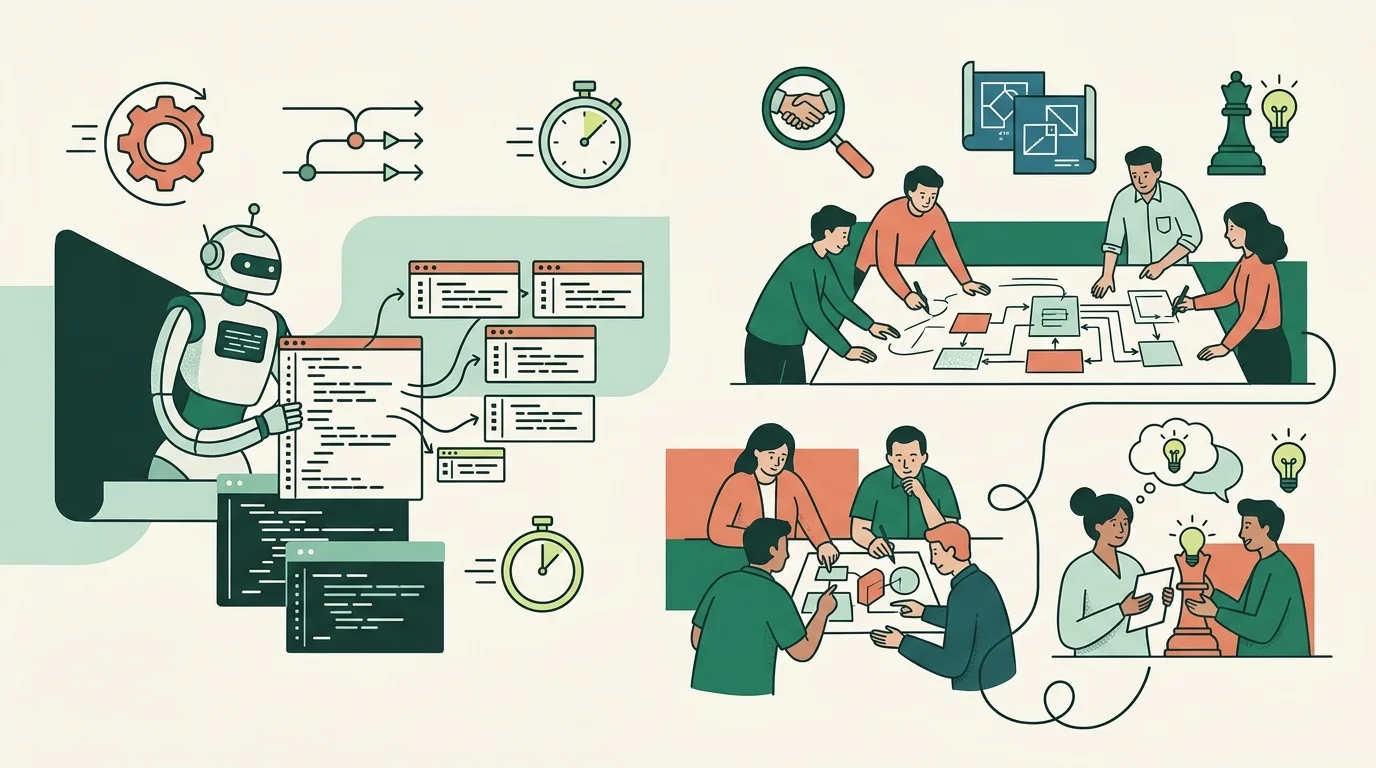
'Coding with AI' indeed offers tremendous efficiency for repetitive and standard tasks. AI can quickly generate code templates, write basic functions, or assist in debugging. However, there are significant limitations:
- Business Context Understanding: AI lacks intrinsic understanding of business objectives, company culture, or market dynamics. It cannot ask "why" or comprehend the nuances behind client needs.
- True Innovation: AI operates based on existing data. Its ability to create truly new, innovative solutions, or those outside learned patterns, is limited.
- Handling Ambiguity: Business requirements are often unclear or ambiguous. Humans have the ability to interpret, discuss, and reformulate problems until the right solution is found.
The Invaluable Role of Software Houses: Business Understanding, Complex System Architecture, and IoT Integration
This is where the invaluable role of software houses shines. We at OmindTech believe that human expertise is crucial in:
- Deep Business Understanding: Translating client's business visions and problems into specific technical requirements and effective solutions.
- Complex System Architecture: Designing and building scalable, secure, and maintainable system frameworks, especially for solutions involving multiple components and platforms (e.g., ERP, CRM, e-commerce).
- IoT Integration: Integrating Internet of Things (IoT) devices into business systems, ensuring data flows smoothly, securely, and can be analyzed to yield valuable insights. This requires a deep understanding of hardware, software, and networks.
Leveraging 'AI Agents' for Efficiency: Automating Repetitive Tasks, Not Replacing Innovation
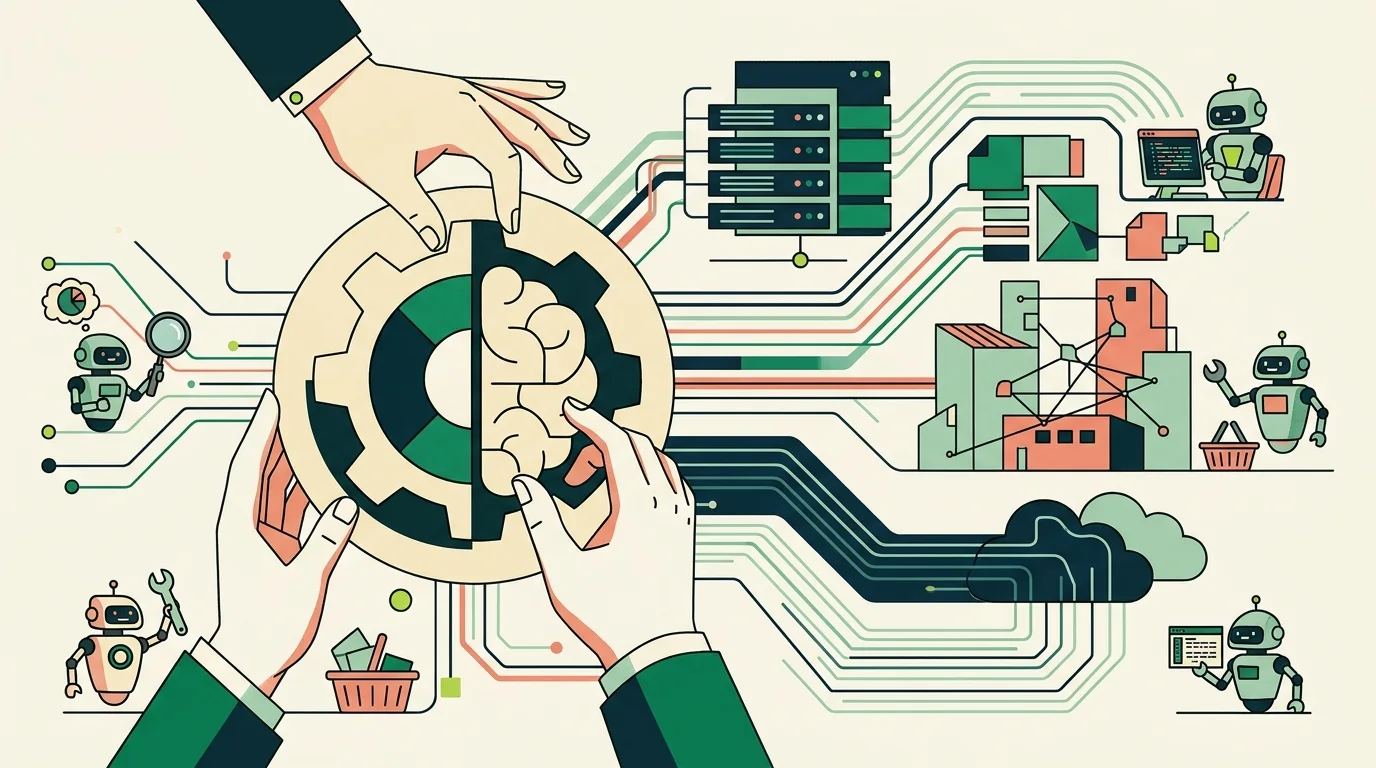
Instead of fear, software houses can embrace AI Agents as incredibly powerful tools. AI Agents can be used for:
- Automated Testing: Running thousands of test cases faster and more accurately.
- Infrastructure Management: Automating deployment, monitoring, and scaling applications.
- Code Analysis: Identifying potential bugs, security vulnerabilities, and optimization opportunities earlier.
By delegating these repetitive tasks to AI, development teams can focus on higher-value aspects: innovation, unique solution design, and business strategy.
New Opportunities: Developing AI-Based Solutions and Helping Clients Adapt
The advent of AI also opens up new opportunities for software houses. We can help clients:
- Develop AI-Based Solutions: Building applications that leverage AI for predictive data analysis, personalization, business process automation, or intelligent chatbots.
- Integrate AI into Legacy Systems: Modernizing legacy systems by adding AI capabilities to enhance efficiency and competitiveness.
- AI Strategy Consulting: Providing guidance on how companies can effectively utilize AI in their business strategies.
Adaptation Strategies: Focus on Customization Expertise, Consulting, and AI Project Management
To remain relevant, software houses need to adopt several key strategies:
- Focus on Custom and Niche Solutions: Moving away from easily automated AI boilerplate development and shifting towards highly specific, complex solutions that require deep business domain understanding.
- Become Technology and Strategy Consultants: Playing a greater role as strategic advisors who help clients identify problems, design innovative solutions, and navigate the ever-changing technological landscape.
- Develop AI Expertise: Building teams with expertise in machine learning, data science, and AI integration, capable of managing complex projects with AI components.
- Master System Integration: Becoming experts in connecting various systems, both new and old, including IoT integration and AI platforms.
Conclusion: Software Houses Remain Relevant and Vital with Transformation and a Focus on Strategic Value
The AI phenomenon has indeed transformed the face of the technology industry, but it has not eliminated the need for software houses. On the contrary, AI triggers an evolution, pushing software houses to level up from mere code providers to innovators, solution architects, and strategic consultants.
Summary of Key Points: Underlining the Relevance of Adaptive Software Houses
- AI is a tool, not a replacement for human expertise in innovation and business understanding.
- Software houses remain vital for complex system architecture, multi-platform integration (including IoT), and deep business context understanding.
- Adopting AI Agents can enhance operational efficiency, freeing up time to focus on strategy and innovation.
- New opportunities arise in developing AI-based solutions and AI adaptation consulting.
Next Steps for Readers: Concrete Strategies for Software Houses to Thrive in the AI Era
If you are a leader at a software house or a company that relies on technology, here are concrete steps you can take:
- Invest in Human Resources with AI Expertise: Train your team in machine learning, data science, and prompt engineering to optimize the use of AI tools.
- Redefine Your Value Proposition: Emphasize your ability to solve complex business problems, build robust architectures, and integrate diverse solutions, rather than just writing code.
- Become a Strategic Partner: Actively understand client business objectives and offer strategic insights on how technology, including AI, can be a driver of growth.
- Explore AI Services: Develop new service offerings centered on AI consulting, custom AI application development, or AI integration into existing systems.
By taking these proactive steps, software houses will not only survive but thrive, becoming key players in shaping the digital future in the AI era.
Join the conversation.
Read reader responses, ask a question, or share your experience.
Keep exploring.
All articles
Technology
Programmers in the AI Era: Collaborators or Replacements?
The rise of Artificial Intelligence sparks a big question: will the role of programmers diminish? At OmindTech, we see this not as a threat, but an evolution. AI actually opens new opportunities, transforming programmers from mere code writers into innovative solution architects shaping the future of technology.

Business Systems
Orkesa.id: Business Transformation with OmindTech's Integrated System
Imagine an orchestra where every instrument plays in perfect harmony, creating a beautiful symphony. That's how Orkesa.id works for your business. At OmindTech, we understand that managing various operational aspects – from finance to customer interactions – can be a significant challenge. Orkesa.id emerges as a digital conductor, unifying ERP, CRM, sales automation, and even chatbots, transforming chaos into a symphony of efficiency and growth.

Business Systems
Guide to Choosing Digital Approval Workflows: User Needs
Ever felt bogged down by piles of paperwork or endless email chains just to get a single approval? For many companies, complex approval processes are a major productivity bottleneck. This article will guide you on how to choose and implement the right digital approval workflow, starting from the most important voice: your users' needs.
LET’S WORK TOGETHER
Start with your story.
One conversation can open up a new perspective. Tell us about your challenge.