
Technology / OmindTech Journal
Behind the Scenes: The Technology That Makes Netflix and Disney+ Accessible to Millions of Users
Have you ever wondered how streaming platforms like Netflix and Disney+ can handle millions of simultaneous users without disruption? This article will delve into the underlying technology behind this marvel.

How Apps Like Netflix and Disney+ Are Built: A Deep Dive
Streaming services like Netflix, Disney+, and others have revolutionized how we consume entertainment content. In the past, we had to buy DVDs or wait for TV schedules. Now, thousands of movie and TV show titles are available at our fingertips, anytime and anywhere.
However, have you ever paused to consider how all of this is possible? How are these platforms able to serve millions of users concurrently, providing a seamless and uninterrupted streaming experience?
In this article, we will delve into the world of technology behind these giant streaming services. We will explore the system architecture, infrastructure, and various optimizations that enable Netflix, Disney+, and others to deliver high-quality content to a global audience.
System Architecture: The Foundation of Scalability
At the core of every successful streaming platform is a robust and scalablesystem architecture. This means the system must be able to handle sudden spikes in user traffic without experiencing performance degradation or even downtime..
Netflix, for example, uses a microservicesarchitecture. This means their applications are broken down into small, independent components called microservices.Each microservice is responsible for a specific function, such as movie recommendations, account management, or video playback.
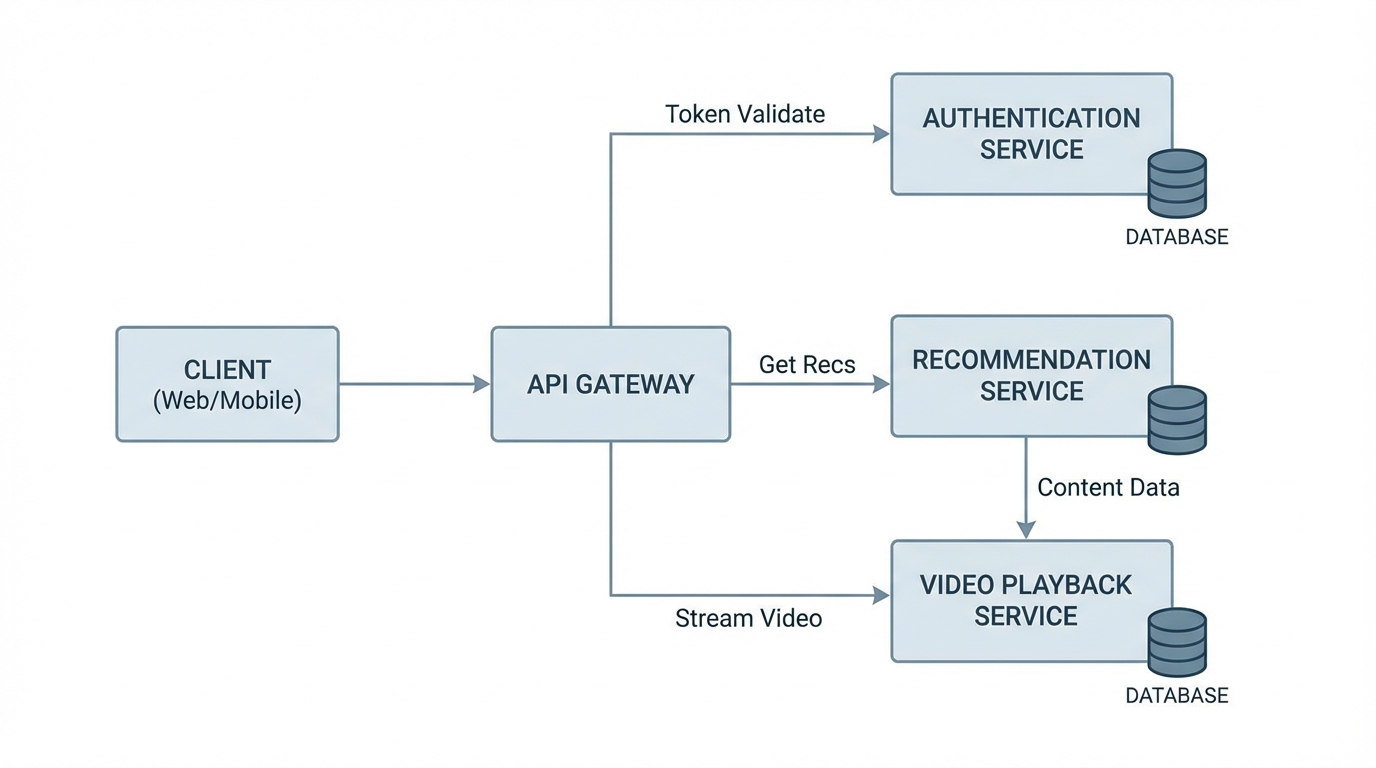
The advantages of a microservices architecture are:
- Scalability: Each microservice can be scaled independently, depending on the need. If the video playback service experiences a traffic surge, only that service needs its capacity increased.
- Resilience: If one microservice fails, other microservices will continue to function. This ensures that the platform remains available even if there are issues.
- Flexibility: Development teams can work on different microservices simultaneously, without interfering with each other. This accelerates development cycles and enables faster innovation.
In our experience at OmindTech, designing scalable microservices architectures is crucial for any high-traffic application. We often use containerization and orchestration technologies like Docker and Kubernetes to manage and deploy these microservices efficiently.
Cloud Infrastructure: Unlimited Computing Power
Most streaming platforms, including Netflix and Disney+, rely on cloud infrastructure to run their applications. This means they use servers and computing resources provided by cloud providers like Amazon Web Services (AWS), Google Cloud Platform (GCP), or Microsoft Azure.
Cloud infrastructure offers several advantages, including:
- Scalability: Cloud resources can be dynamically scaled according to demand. If there's a surge in user traffic, platforms can automatically add more servers to handle the load.
- Reliability: Cloud providers offer built-in redundancy and failover, which ensures the platform remains available even if there are issues with hardware or software..
- Cost efficiency: Platforms only pay for the resources they use. This can be much cheaper than building and maintaining data centers themselves.
Netflix, for example, extensively uses AWS. They utilize various AWS services, including EC2 (Elastic Compute Cloud) for running virtual servers, S3 (Simple Storage Service) for storing video content, and CloudFront for content delivery (CDN).
Content Delivery Network (CDN): Accelerating Video Delivery
After video content is stored in the cloud, it needs to be delivered to users quickly and efficiently. This is the function of a Content Delivery Network (CDN).
A CDN is a geographically distributed network of servers worldwide. When a user requests a video, the request is routed to the nearest CDN server. The CDN server then delivers the video to the user from its cache.
The advantages of using a CDN are:
- Faster delivery: Because video is delivered from a server close to the user, latency is reduced, and video loading times become faster.
- Better user experience: Faster video loading times result in a smoother streaming and more satisfying experience.
- Reduced origin server load: Because CDNs handle most video requests, the load on origin servers is reduced.
Netflix uses its own CDN called Open Connect. They collaborate with Internet Service Providers (ISPs) worldwide to place Open Connect servers within their networks. This ensures that Netflix content can be delivered to users at very high speeds.
Video Optimization: Reducing File Size Without Sacrificing Quality
Video content is very large. If streaming platforms deliver uncompressed videos, users would need a very fast internet connection to watch them without buffering.Additionally, storage and bandwidth costs would also be very high.
Therefore, streaming platforms use various video optimization techniques to reduce video file sizes without significantly sacrificing quality. These techniques include:
- Encoding: Using efficient video codecs to compress video. Popular codecs include H.264, H.265 (HEVC), and AV1.
- Adaptive bitrate streaming (ABS): Provides video in several different qualities. The platform automatically selects the quality that best suits the user's internet connection speed. This ensures a smooth streaming experience, even with slow internet connections.
- Chunking: Dividing video into chunks,-which are small. This allows platforms to deliver video incrementally, so users can start watching before the entire file is fully downloaded.
Load Testing: Ensuring Stability Under Pressure
Before launching new features or anticipating traffic surges, streaming platforms conduct load testing to ensure their systems can handle the pressure.
Load testing involves simulating a large number of users accessing the platform simultaneously. This helps identify bottlenecks and potential performance issues.
At OmindTech, we emphasize the importance of load testing. We use tools like JMeter and Gatling to simulate realistic user scenarios and identify potential performance issues before they impact real users. Load testing is a crucial step in ensuring a stable and reliable streaming experience.
The results of load testing are used to refine the system architecture and optimize server configurations.
Conclusion
Building and maintaining a streaming platform that can serve millions of users is a complex and challenging task. It requires a robust system architecture, cloud infrastructure that is scalable,an efficient content delivery network, and advanced video optimization techniques. By combining these technologies, Netflix, Disney+, and others can deliver a smooth streaming experience to a global audience.
At OmindTech.id, we have deep experience in building and managing streaming systems that are scalable and reliable. If you are interested in learning more about how we can assist you with your streaming needs, feel free to contact us.
Join the conversation.
Read reader responses, ask a question, or share your experience.
Keep exploring.
All articles
Technology
Integrated Financial Apps: The Key to Business Scalability
Discover how integrated financial applications and custom accounting software can slash reconciliation times by 80% and drive limitless business growth.

Technology
Beyond Hype: 3 Tech Trends 2026 Reshaping Indonesian Business
2026 marks the shift from AI experimentation to real-world deployment. From Agentic AI to PDP-compliant data sovereignty, discover how business infrastructure in Indonesia is evolving from passive to autonomous.

Technology
Beyond New Computers: Digitalizing Schools for Indonesia 2045
Why is a stack of computers in a school lab never enough? We dissect the harsh reality of digital transformation in Indonesian education and how ecosystem-driven digitalization can foster world-class talents for Golden Indonesia 2045.
LET’S WORK TOGETHER
Start with your story.
One conversation can open up a new perspective. Tell us about your challenge.