
Technology / OmindTech Journal
Integrated Financial Apps: The Key to Business Scalability
Discover how integrated financial applications and custom accounting software can slash reconciliation times by 80% and drive limitless business growth.

Table of Contents
- 1. Breaking the Barriers of Business Scalability Through Financial Efficiency
- 2. Understanding Integrated Financial Applications: More Than Just Cash Recording
- 3. Automated Accounting: How Accounting Software Eliminates Human Error
- 4. Inter-system Integration: The Pivot Point of Strategic Decision Making
- 5. Breaking Free from Traditional Financial Hurdles with OmindTech
- 6. Future-Proof Architecture: Must-Have Features of Modern Financial Apps
- 7. Transformation Blueprint: From Data Chaos to Financial Clarity
- 8. Tactical Guide to Choosing the Right Accounting Software for Your Scale
- 9. Looking Ahead: Custom FinTech Investment as a Profit Engine
Key Takeaways
- Financial efficiency is not just about cutting costs; it is about building a robust data foundation to power limitless business scalability.
- Modern integrated financial applications eliminate data silos, synchronizing all departments in real-time.
- Building custom accounting software with OmindTech provides unmatched flexibility compared to rigid, cookie-cutter SaaS templates.
- Financial report automation slashes human error rates close to zero percent and significantly reduces monthly reconciliation cycles.
1. Breaking the Barriers of Business Scalability Through Financial Efficiency
Many businesses boasting incredible products and aggressive sales teams eventually hit an invisible ceiling. Why does this happen? The answer is frequently found in the back office: financial management that fails to keep pace with the speed of growth. When daily transactions jump from dozens to thousands, manual or fragmented semi-digital ledger systems begin to buckle under pressure. This bottleneck is not just an administrative nuisance; it is a direct threat to business survival.
In the modern industrial landscape, financial efficiency acts as the primary fuel for expansion. Without absolute visibility over cash flows, profit projections, and operational overhead, any expansion move is like taking a step in total darkness. Companies require a rock-solid foundation to ensure every single rupiah entering and leaving is logged with high precision, ready to be pulled at any moment for strategic analysis.
Scalability demands speed and accuracy. When executive teams have to wait until the end of the following month just to review the current month's profit and loss statements, invaluable market opportunities are missed. Consequently, modernizing financial infrastructure by transitioning to interconnected digital systems is no longer an optional luxury—it is an urgent necessity for companies striving to stay competitive and highly adaptive to market shifts.
2. Understanding Integrated Financial Applications: More Than Just Cash Recording
At its core, an integrated financial application is a digital ecosystem that unifies various financial functionalities into one centralized platform. It is far more than just a digital version of your physical cash book. This system encompasses accounts receivable, accounts payable, employee payroll, asset management, tax reporting, and automated bank reconciliation.
The true power of an integrated platform lies in its ability to stream data seamlessly across these functions. When the sales division issues a new invoice, the system automatically updates accounts receivable projections, adjusts inventory levels, records potential tax liabilities, and updates the executive dashboard in real-time. There is no longer any need for manual CSV exports and imports, which are notoriously prone to data loss or version conflicts.
For operational management, this means total control over workflow efficiency. Employees no longer need to spend hours matching transaction data across multiple disconnected platforms. All information is presented in a centralized, consistent, and highly accurate manner. This integration establishes a single source of truth, eliminating internal debates about the validity of corporate financial metrics.
3. Automated Accounting: How Accounting Software Eliminates Human Error
At the heart of every successful financial system sits a dependable accounting software. Its primary role has evolved from a simple journal-entry typing tool into an intelligent automation engine. Through precisely configured business rules, this software processes routine transactions independently without requiring constant manual intervention.
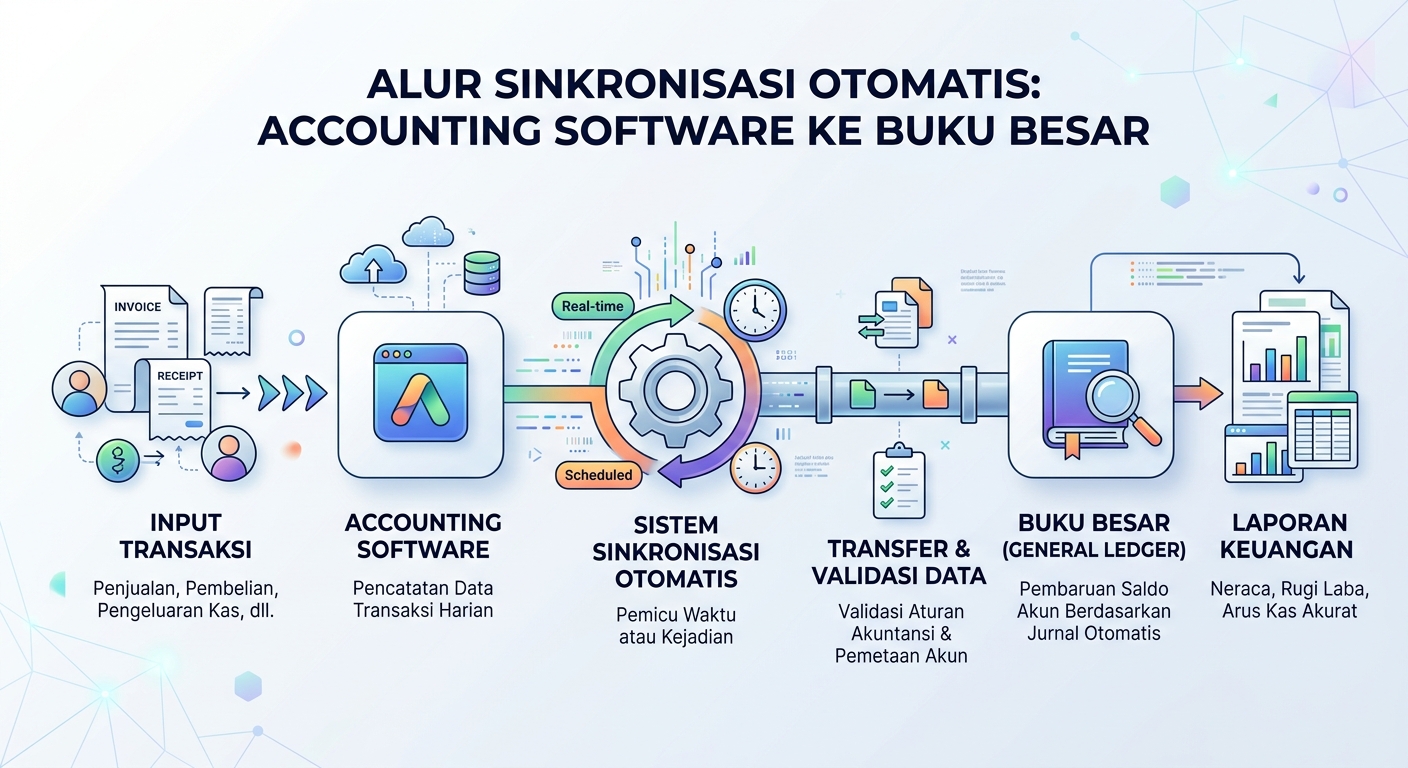
This automation covers the generation of general journals, ledgers, and standard financial statements such as balance sheets, income statements, and cash flow reports. By minimizing manual data entry processes, organizations can compress human error rates down to an absolute minimum. A single misplaced zero on a traditional spreadsheet can severely distort an end-of-year report, but such mishaps are completely prevented by modern systems featuring multi-layered data validation.
Beyond accuracy, the speed of preparing financial statements is dramatically accelerated. Your accounting team is no longer trapped in exhausting administrative loops as month-end closing approaches. Instead, they can transform into strategic advisors who analyze the implications of those figures for the business's future. Automation yields the time and space required for the finance team to focus on product profitability analysis, cost optimization strategies, and refined tax planning.
4. Inter-system Integration: The Pivot Point of Strategic Decision Making
In daily corporate operations, the finance department does not exist in a vacuum. It heavily relies on data from other departments, such as sales, logistics, procurement, and human resources. If financial systems are isolated from these divisions, an information gap is created that severely cripples business agility.
Inter-system integration, such as linking core accounting software with Point of Sales (POS) systems, e-commerce platforms, or Customer Relationship Management (CRM) databases, is a genuine game-changer. When a transaction occurs at a retail outlet or an online store, sales data flows directly into the financial system without manual re-entry. Management can instantly review today's sales performance along with net profit margins on their dashboards by evening.
This real-time information is invaluable currency for business leaders to make swift, precise strategic calls. Do we need to restock raw materials immediately? Did last week's promotional campaign deliver a positive ROI? All these questions are answered instantly based on actual, validated data rather than mere intuition or guesswork. In an era where market dynamics change by the hour, speed of decision-making is the ultimate key to winning the competition.
5. Breaking Free from Traditional Financial Hurdles with OmindTech
Many mid-to-large-scale enterprises in Indonesia still grapple with inefficient traditional financial management. A few classic challenges we frequently encounter on the ground include:
- Double Entry Manual Accounting: Re-entering data from one system to another, wasting productive hours and multiplying error rates.
- Slow Bank Reconciliation: Manual matching of bank statements with internal ledgers that takes days to finalize.
- Lack of Cash Flow Visibility: The inability to pinpoint the company's real-time cash position, hindering short-term investment decisions.
- Over-reliance on Complex Spreadsheets: Convoluted Excel formulas prone to breaking when accessed by multiple users simultaneously.
At OmindTech, we understand that every business possesses unique workflows that cannot always be shoehorned into off-the-shelf accounting software. That is why we provide custom financial software development services designed specifically to solve your unique operational bottlenecks.
Using a highly user-centric approach, our software architects build systems that integrate flawlessly with your existing IT infrastructure. We automate bank reconciliation through direct banking API integrations, build highly interactive and intuitive analytical dashboards, and eliminate duplicate data entries via intelligent, secure system synchronization.
6. Future-Proof Architecture: Must-Have Features of Modern Financial Apps
Before deciding to build or purchase a financial application, you must ensure that the system possesses modern features aligned with today's technological landscape. Here are some essential features that should not be overlooked:
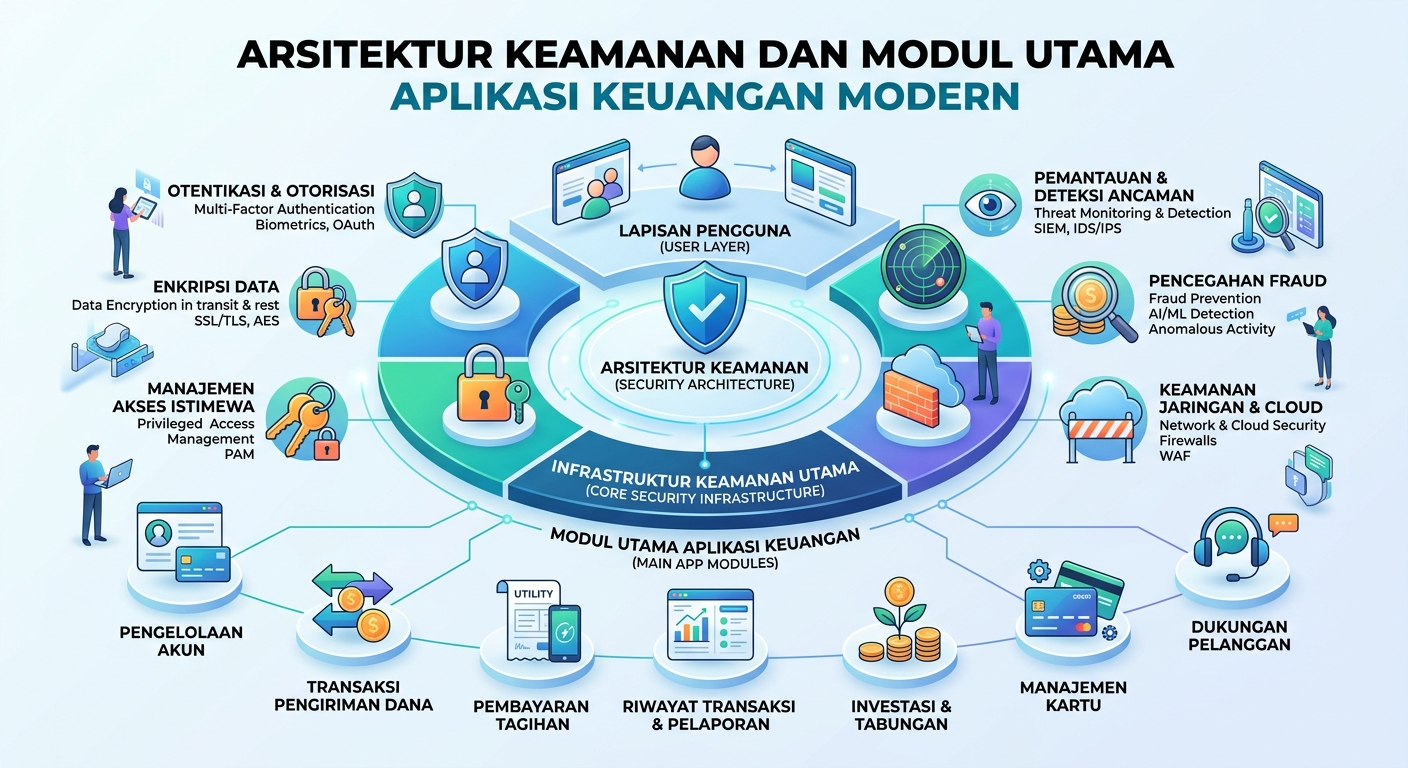
Enterprise-Grade Security
Financial data is a company's most sensitive asset. Modern financial applications must implement end-to-end data encryption (both at rest and in transit), multi-factor authentication (MFA), and Role-Based Access Control (RBAC). An audit trail feature that logs every single data modification by users is also non-negotiable to prevent internal fraud.
Open and Flexible API Integration
A great system must communicate effortlessly with other third-party applications. Robust API (Application Programming Interface) support allows your financial application to connect seamlessly with payment gateways, enterprise ERPs, logistics systems, and official government tax reporting platforms.
Interactive Real-Time Analytical Dashboards
Presenting financial data in endless rows and columns of numbers often complicates visual analysis. A modern financial dashboard must visualize complex financial data into interactive charts and graphs that are easy to digest at a glance. This feature helps management monitor key financial KPIs on a daily basis.
7. Transformation Blueprint: From Data Chaos to Financial Clarity
To give you a real-world picture of the power of financial technology integration, let us look at one of our highly successful digital transformation projects. Our client, a national distribution company in Indonesia, previously faced enormous hurdles managing receivables from their thousands of partner retail stores.
Billing processes were frequently delayed because field sales teams were slow to report payment confirmations back to the finance team at headquarters. As a result, the company's cash flow stalled, and relationships with merchant partners were often strained due to discrepancies in outstanding debt records. They required an agile and dependable solution to fix this financial supply chain bottleneck.
Custom Solution Delivered by OmindTech:
- Integrated Mobile Sales App: We built a dedicated application for field sales agents that connects directly to the core accounting software at headquarters.
- Instant Payment Notifications: The system automatically dispatches billing notifications via WhatsApp and email to retail partners, complete with instant virtual account payment links.
- Automated Reconciliation: The moment a payment is made, the system updates the receivable status to 'paid' within seconds without requiring manual intervention from finance staff.
Real Results Achieved:
Within three months of full deployment, our client successfully slashed their Days Sales Outstanding (DSO) by 45%. Their finance team can now finalize monthly bank reconciliations in just 1 day, down from the 10 business days it used to take. This digital transformation not only rescued the company's cash flow but also significantly bolstered partner trust.
8. Tactical Guide to Choosing the Right Accounting Software for Your Scale
Choosing or building accounting software is a long-term decision that will impact your business operations for years to come. Therefore, strategic planning is required to ensure this technology investment yields the highest return. Here is a practical framework you can follow:
- Identify Main Pain Points: Understand the largest bottlenecks in your current financial operations. Is it slow billing cycles, difficulties in multi-branch consolidation, or complex tax compliance?
- Evaluate Flexibility vs. Ease of Use: Ensure the software you choose features a user-friendly interface while packing robust functionality to accommodate future business needs.
- Consider Scalability Factors: Select a system that can grow alongside your enterprise. You should not have to replace your entire financial infrastructure just because your transaction volume doubles next year.
- Analyze Total Cost of Ownership (TCO): Beyond the initial development or licensing fees, calculate recurring maintenance costs, server hosting, employee training, and post-implementation technical support.
For enterprises with complex operational workflows, opting for a bespoke custom software development solution is often the path with the highest ROI. Custom solutions guarantee that the technology aligns perfectly with your proven, successful business processes, rather than forcing your operations to bend to the rigid templates of off-the-shelf software.
9. Looking Ahead: Custom FinTech Investment as a Profit Engine
Financial technology is evolving at breakneck speed. Looking ahead, the integration of artificial intelligence (AI) and machine learning in financial applications will become increasingly dominant, enabling hyper-accurate cash flow forecasting and early detection of fraudulent patterns. Delaying investment in financial system modernization means letting your competitors sprint ahead with vastly superior operational efficiency.
Viewing technology strictly as a cost center is a legacy mindset that must be left behind. In this digital era, an integrated financial application and dependable accounting software are strategic profit drivers. They grant you absolute clarity of direction, speed of execution, and maximum operational efficiency to propel your business to the next level.
Are you ready to revolutionize your company's financial management and unlock your true business growth potential? We at OmindTech are ready to help you design, build, and deploy a world-class custom financial application tailored to your exact business vision.
Reach out to our expert team at OmindTech today for a deep, free consultation regarding your corporate financial digitization needs. Let us build a rock-solid technological foundation for a bright, scalable business future together.
Join the conversation.
Read reader responses, ask a question, or share your experience.
Keep exploring.
All articles
Technology
Beyond Hype: 3 Tech Trends 2026 Reshaping Indonesian Business
2026 marks the shift from AI experimentation to real-world deployment. From Agentic AI to PDP-compliant data sovereignty, discover how business infrastructure in Indonesia is evolving from passive to autonomous.

Technology
Beyond New Computers: Digitalizing Schools for Indonesia 2045
Why is a stack of computers in a school lab never enough? We dissect the harsh reality of digital transformation in Indonesian education and how ecosystem-driven digitalization can foster world-class talents for Golden Indonesia 2045.

Technology
Beyond Generic AI: Why Your Business Needs Tailor-Made AI
Exploring the modern operational efficiency revolution, this article reveals why generic AI tools in the market are no longer enough and how custom, tailor-made AI solutions become your golden key to market dominance with OmindTech.
LET’S WORK TOGETHER
Start with your story.
One conversation can open up a new perspective. Tell us about your challenge.