
Technology / OmindTech Journal
Beyond New Computers: Digitalizing Schools for Indonesia 2045
Why is a stack of computers in a school lab never enough? We dissect the harsh reality of digital transformation in Indonesian education and how ecosystem-driven digitalization can foster world-class talents for Golden Indonesia 2045.

Table of Contents
- 1. Introduction: Why Indonesian Education Needs Digital Transformation, Not Just Device Procurement
- 2. Dissecting the Difference: Computerization vs. Educational Digitalization
- 3. The Strategic Role of AI in Personalizing Learning in Schools
- 4. Digital Ecosystem: Integrating School Applications for Operational Efficiency
- 5. Challenges and Opportunities of Educational Digitalization Towards Golden Indonesia 2045
- 6. Digital Transformation Roadmap for Educational Institutions in Indonesia
- 7. Conclusion: Building the Foundation of a Smart Generation Through Sustainable Digitalization
Key Takeaways:
- Computerization is merely a change of medium (from paper to screen), whereas digitalization fundamentally transforms workflows, learning experiences, and collaboration through real-time data integration.
- Artificial Intelligence (AI) acts as a catalyst for personalized learning, allowing each student to progress according to their unique learning pace.
- Integrating school applications into a single unified digital ecosystem eliminates data silos and boosts operational efficiency by up to 40%.
- Looking ahead to Golden Indonesia 2045, digital transformation is no longer a luxury, but a mandatory foundation to produce globally competitive human resources.
1. Introduction: Why Indonesian Education Needs Digital Transformation, Not Just Device Procurement
For the past few decades, the indicators of technological progress in Indonesian schools have often been measured by physical attributes: the number of computers in the laboratory, the availability of projectors in classrooms, or the distribution of free devices to students. While well-intentioned, this policy frequently falls into the trap of "commodity purchasing" without a corresponding shift in learning paradigms.
We at OmindTech view this phenomenon as a hidden bottleneck. Supplying thousands of brand-new laptops without robust software infrastructure and cultural readiness among educators will only lead to stacks of dusty hardware. These devices are often reserved for simple administrative tasks or year-end exams (like UNBK in the past), while daily teaching and learning continue with 19th-century conventional methods.
Approaching the momentum of Golden Indonesia 2045, global demands on human resource quality are soaring. We no longer need graduates who are merely proficient at typing or operating spreadsheets. Indonesia needs problem solvers, critical thinkers, and innovators who are fluent in data ecosystems. Therefore, the focus must shift from mere "device procurement" toward "comprehensive digital transformation."
2. Dissecting the Difference: Computerization vs. Educational Digitalization
To move in the right direction, we must clarify the dividing line between computerization and digitalization. A failure to understand these two concepts often depletes school budgets without producing any tangible academic impact.
- Computerization is the process of converting work tools from manual to digital without modifying the core business processes or teaching methodologies themselves.
- Example: A teacher writes lesson materials in Microsoft Word and prints them out, or digitizes printed textbooks into static PDF formats without any added interactivity. Students submit assignments via email or Google Drive without any automated learning performance analysis.
- Digitalization is a fundamental transformation that utilizes technology to create new teaching methodologies, enhance operational efficiency, and connect all school elements within a living data ecosystem.
- Example: The implementation of interactive Learning Management Systems (LMS) that track student study hours, identify uncomprehended materials in real-time, dynamically recommend study resources, and automate grading so teachers can focus on mentoring students.
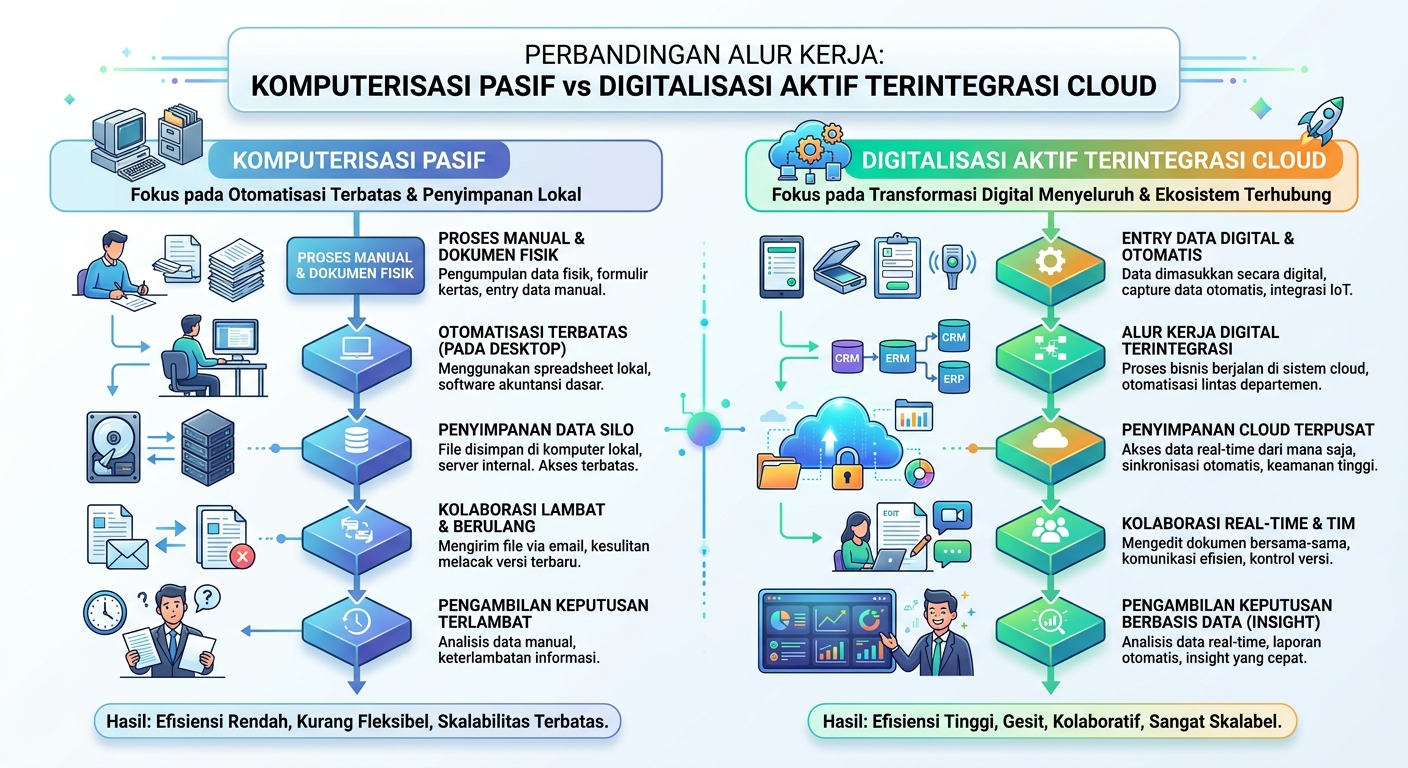
With digitalization, data no longer sits isolated in individual computers of staff members, but flows and integrates to support rapid, data-driven decision-making for principals and foundation boards.
3. The Strategic Role of AI in Personalizing Learning in Schools
One of the greatest challenges for teachers in Indonesia is managing highly heterogeneous classrooms of 30 to 40 students with vastly different learning paces. This is where Artificial Intelligence (AI) comes in as a transformative solution, not to replace teachers, but to act as a highly personalized intelligent assistant.
Adaptive Learning
AI-powered systems can analyze how a student answers questions step-by-step. If a student struggles to comprehend a fraction concept in mathematics, the AI will automatically reduce the difficulty level or present relevant animated explanation videos before serving the next test. Conversely, students who learn faster will be challenged with more complex tasks without having to wait for the rest of the class.
Predictive Analytics to Prevent Student Dropouts
AI is also capable of providing predictive analysis to teachers. By mapping daily grading data, attendance rates, and active student participation on digital platforms, AI can detect students at risk of underachievement or dropping out weeks before it actually happens. This valuable insight allows teachers to carry out highly effective preventative interventions.
4. Digital Ecosystem: Integrating School Applications for Operational Efficiency
Another bottleneck we frequently encounter in the field is the phenomenon of "application islands." Many schools boast about having numerous digital systems: one application for attendance, one for e-learning, one for tuition billing, and another for reporting grades to the ministry. However, these systems do not talk to each other.
Administrative staff must manually input student data repeatedly into each different platform. This creates massive inefficiencies and a high risk of human error in data entry. The solution to this complex issue is establishing a unified Integrated Digital Ecosystem.
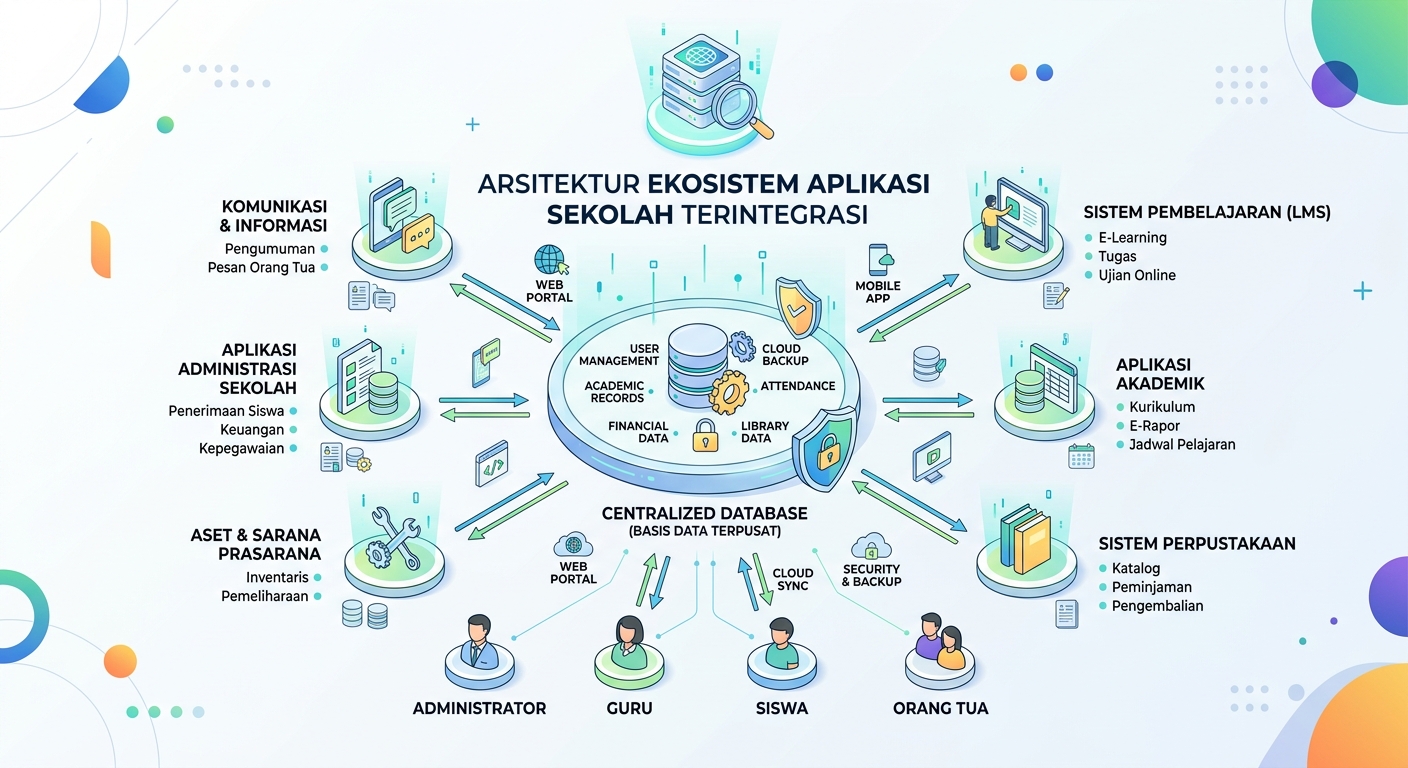
An ideal school application ecosystem should connect:
- Academic Information System (SIAKAD): Manages curricula, class schedules, grades, and academic track records.
- Financial Management System: Automates tuition billing, records operational expenses, and sends automated notifications to parents.
- Parent Portal: Provides direct visibility to parents regarding daily attendance, grades, and school announcements, eliminating bureaucratic communication barriers.
- Learning Management System (LMS): Virtual classrooms where teachers distribute creative modules and interactive quizzes.
When all these modules are seamlessly integrated via robust APIs (Application Programming Interfaces), school management can monitor financial health and academic performance through a single centralized executive dashboard.
5. Challenges and Opportunities of Educational Digitalization Towards Golden Indonesia 2045
Heading into 2045, Indonesia is projected to enjoy its demographic dividend peak, with 70% of the population in their productive age. However, this demographic bonus could turn into a demographic disaster if our educational quality fails to adapt.
Real Challenges in the Field
- Infrastructure Disparity: High-speed internet connectivity is not yet evenly distributed across the 3T (Underdeveloped, Frontier, and Outermost) regions.
- Cultural Resistance & Digital Literacy: Many senior educators feel uncomfortable with digital workflow changes and prefer the comfort zone of conventional methods.
- Data Security: Data breaches of students' and teachers' personal details pose a major threat if digital platforms are built without strict encryption and robust data security protocols.
Open Opportunities
- Equal Access to Education: Through digitalization, students in remote regions can access the same high-quality learning materials as students in major cities.
- Long-Term Cost Efficiency: Drastic reductions in paper usage (going paperless) as well as administrative automation will significantly slash operational expenses on a larger scale.
- Global Job Readiness: Students accustomed to using digital collaborative platforms during school will be far more prepared to face the modern global workforce, which is increasingly remote and cloud-dependent.
6. Digital Transformation Roadmap for Educational Institutions in Indonesia
Executing a digital transformation cannot be done overnight. It requires tactical and structured planning to prevent technology investments from going to waste.
Here is a 4-phase roadmap we recommend for educational institutions in Indonesia to adopt:
Phase 1: Assessment and Basic Infrastructure Strengthening
Before rolling out any software, ensure the school's Wi-Fi network is stable and capable of handling concurrent connections from hundreds of devices. Conduct digital literacy assessments of teachers to map out targeted training needs.
Phase 2: Centralized Data Consolidation (Single Source of Truth)
Migrate all manual databases (scattered spreadsheets, physical logs) into a secure cloud database system. In this phase, schools must begin adopting a core school management system that unifies data for students, teachers, and administrative staff.
Phase 3: Digital Learning Integration & AI Personalization
Deploy LMS across all daily learning activities. Begin integrating AI-powered features to assist teachers in designing personalized study materials and executing automated progress analysis on student learning paths.
Phase 4: Data-Driven School Optimization
By this stage, schools are fully mature digitally. Principals and foundation boards utilize real-time analytical dashboards to monitor attendance, financial performances, parent satisfaction levels, and student graduation success rates to formulate strategic policies.
7. Conclusion: Building the Foundation of a Smart Generation Through Sustainable Digitalization
The journey toward Golden Indonesia 2045 is not a short-distance sprint, but a marathon determined by the decisions we make today. Placing computer hardware in schools is a good first step, but letting it operate without an integrated digital ecosystem is a missed opportunity.
True technology does not just sit on a computer desk; it lives inside every teaching interaction, administrative efficiency, and seamless collaboration among all school stakeholders. When a school successfully transforms into an adaptive, data-driven institution, we are not just educating students to pass exams, we are shaping self-reliant innovators ready to lead the world.
We at OmindTech are fully committed to guiding educational institutions across Indonesia in realizing this technological leap. Through premium custom software engineering, secure system integrations, and AI-powered technological development, let us build the ultimate digital architecture for the future generation.
Join the conversation.
Read reader responses, ask a question, or share your experience.
Keep exploring.
All articles
Technology
Integrated Financial Apps: The Key to Business Scalability
Discover how integrated financial applications and custom accounting software can slash reconciliation times by 80% and drive limitless business growth.

Technology
Beyond Hype: 3 Tech Trends 2026 Reshaping Indonesian Business
2026 marks the shift from AI experimentation to real-world deployment. From Agentic AI to PDP-compliant data sovereignty, discover how business infrastructure in Indonesia is evolving from passive to autonomous.

Technology
Beyond Generic AI: Why Your Business Needs Tailor-Made AI
Exploring the modern operational efficiency revolution, this article reveals why generic AI tools in the market are no longer enough and how custom, tailor-made AI solutions become your golden key to market dominance with OmindTech.
LET’S WORK TOGETHER
Start with your story.
One conversation can open up a new perspective. Tell us about your challenge.