
Technology / OmindTech Journal
The Technology Behind AI Image Generators: Understanding How They Work and Their Implications
This article delves into the underlying technology of AI image generators, from diffusion models to generative adversarial networks (GANs), and their implications for the creative industry and society. We will explore how AI creates stunning images and what it means for the future of art and design.

The Technology Behind AI Image Generators: Understanding How They Work and Their Implications
AI image generators have become one of the most exciting breakthroughs in artificial intelligence (AI) in recent years. From generating stunning art to rapidly prototyping designs, their potential applications are vast. But have you ever wondered how this technology actually works? This article will delve into the technology behind AI image generators, exploring how these advanced models operate and their implications for the creative industry and society.
What Are AI Image Generators?
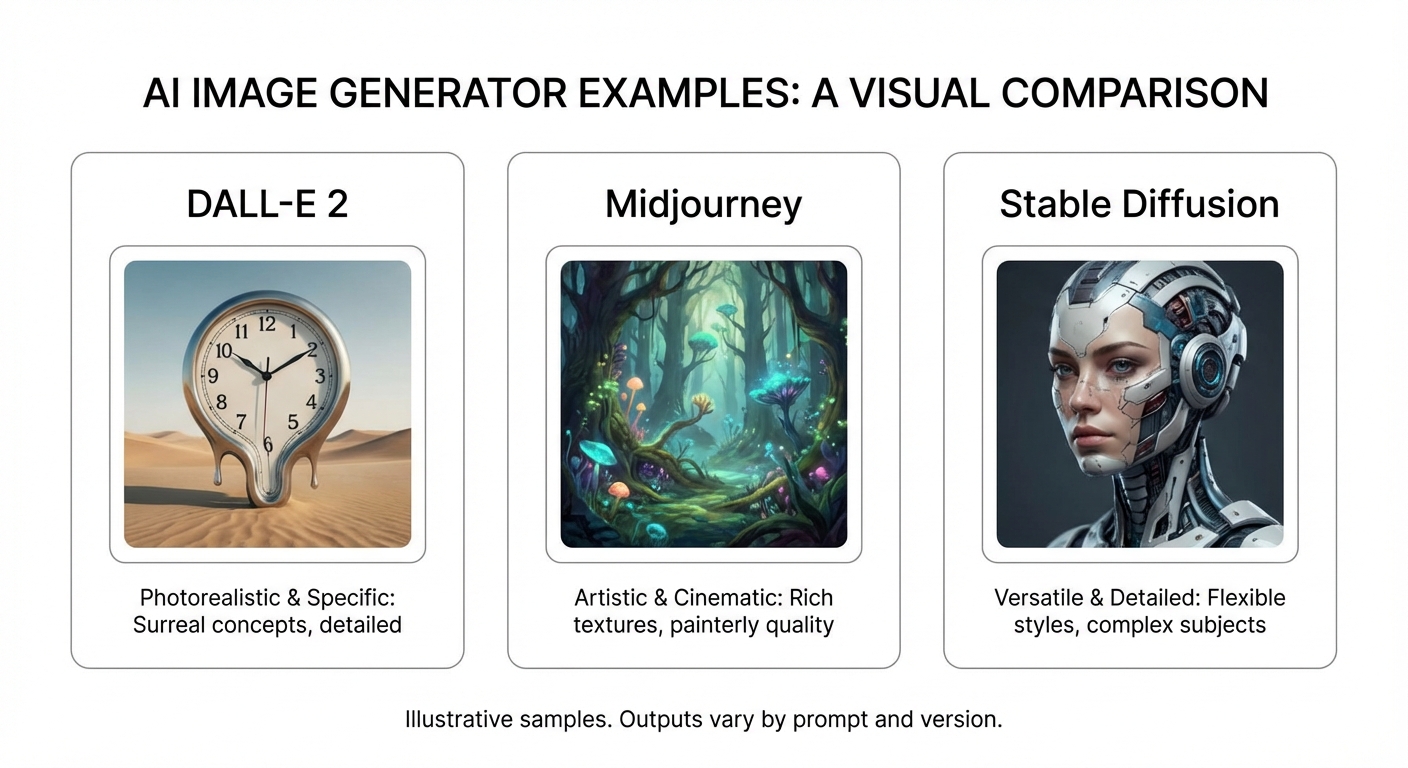
AI image generators are computer programs that use machine learning to create images from text or image inputs. They are trained on large datasets of images, enabling them to learn the relationships between words and visuals. When given a text command (prompt), they can generate new images that match that description. Popular examples include DALL-E 2, Midjourney, and Stable Diffusion.
In our experience at OmindTech.id, understanding the fundamentals of this technology is crucial for leveraging its full potential across various business and creative applications.
Diffusion Models: The Core Foundation of AI Image Generators
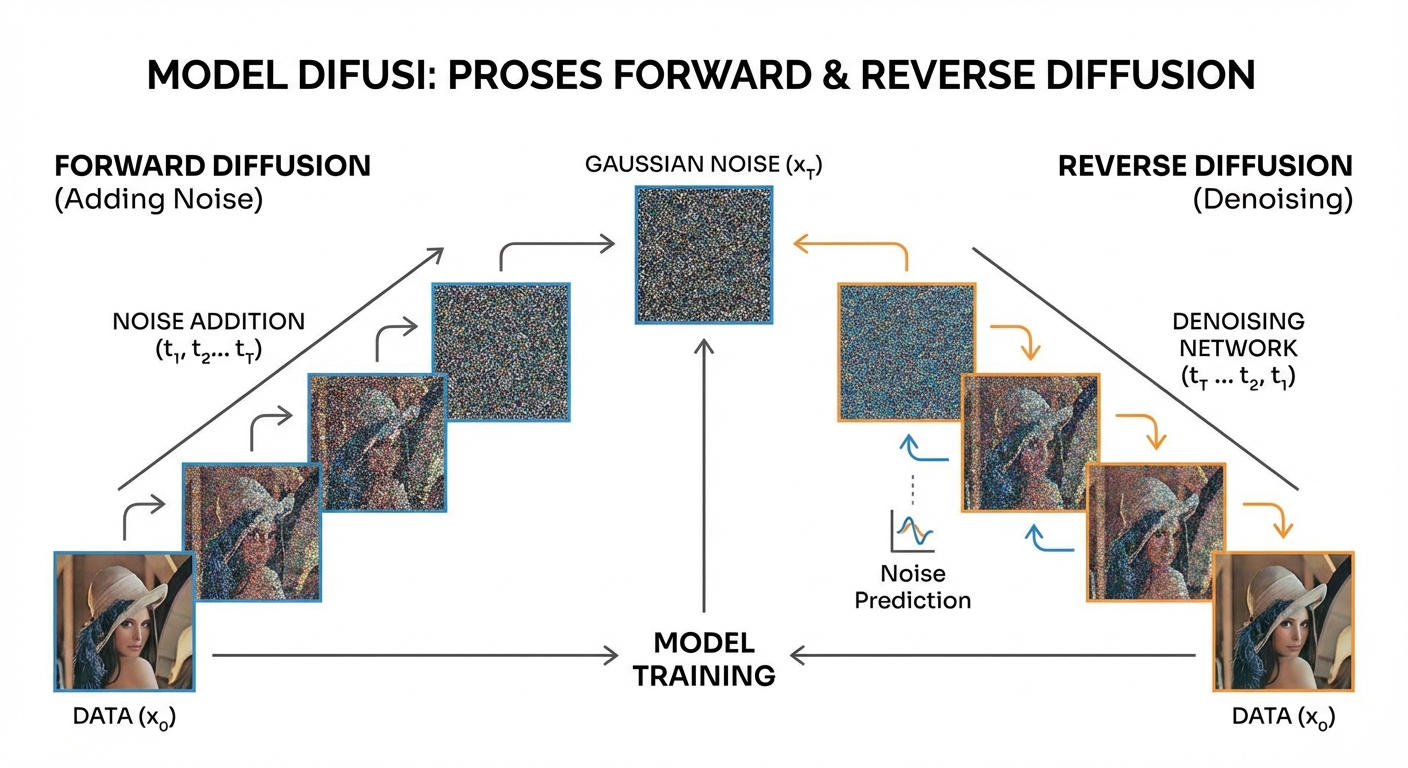
One of the key technologies underlying many modern AI image generators is diffusion models. Diffusion models work by gradually adding noise to an image until it becomes entirely random noise. This process is called forward diffusion. Subsequently, the model is trained to reverse this process, gradually removing noise from a noisy image to reconstruct the original image. This process is called reverse diffusion.
How Diffusion Models Work
- Forward Diffusion (Noise Addition Process): The original image is gradually transformed into random noise through the addition of Gaussian noise at each step.
- Reverse Diffusion (Noise Removal Process): The model is trained to predict and remove noise from the image, iteratively refining it until it resembles a coherent image.
- Generative Process: By starting from random noise, the model can use the reverse diffusion process to generate new images that match the training data distribution.
Advantages of Diffusion Models
- High Image Quality: Diffusion models tend to produce images with higher quality compared to other methods, especially in terms of detail and realism.
- Diversity: They can generate a diverse range of images, even from the same prompt, due to the probabilistic nature of the diffusion process.
- Control: The diffusion process can be controlled in various ways, allowing users to influence the characteristics of the generated images.
Generative Adversarial Networks (GANs): An Alternative Approach
Before diffusion models became dominant, generative adversarial networks (GANs) were the primary architecture used to generate AI images. GANs consist of two neural networks: a generator and a discriminator. The generator attempts to create realistic-looking images, while the discriminator tries to distinguish between images produced by the generator and real images from the training dataset.
GANs Architecture
- Generator: The network responsible for creating images from random noise.
- Discriminator: The network responsible for evaluating whether a given image is real or generated by the generator.
GANs Training Process
The generator and discriminator are trained simultaneously in an adversarial game. The generator tries to fool the discriminator by producing increasingly realistic images, while the discriminator tries to improve its ability to detect fake images. This process continues until the generator produces images realistic enough that the discriminator struggles to differentiate them from real images.
Challenges with GANs
- Training Instability: GANs are notoriously difficult to train due to the imbalance between the generator and discriminator.
- Mode Collapse: The generator can get stuck producing only a few types of images, reducing the diversity of the output.
- Image Quality: While GANs can produce impressive images, their quality is often less consistent compared to diffusion models.
How Do AI Image Generators Understand Text?
The ability of AI image generators to create images from text relies on powerful language models. These models are trained on large text datasets, enabling them to understand the meaning and relationships between words. When given a text prompt, the language model translates that prompt into a numerical representation understandable by the image generator.
CLIP: Bridging Text and Images
CLIP (Contrastive Language-Image Pre-training) is a model developed by OpenAI that plays a crucial role in connecting text and images. CLIP is trained to predict which image best matches a given text description. By training CLIP on large datasets of images and text, it learns to understand the relationship between words and visuals.
Text-to-Image Process
- Text Prompt: The user provides a text prompt describing the desired image.
- Text Encoding: A language model like CLIP converts the text prompt into a numerical representation (embedding).
- Image Generation: The image generator uses the text embedding as a guide to produce a corresponding image.
- Image Refinement: The generated image can be refined through various techniques, such as upscaling and inpainting, to improve quality and detail.
Implications of AI Image Generators
AI image generators have broad implications for various industries and aspects of our lives:
- Creative Industry: Assisting artists, designers, and marketers in generating visual content quickly and efficiently. From creating art concepts to prototyping products, AI image generators can accelerate the creative process and reduce costs.
- Education: Providing powerful tools for visualization and learning. Students and teachers can use AI image generators to create illustrations, diagrams, and animations that explain complex concepts.
- Entertainment: Creating new and immersive entertainment experiences. Game developers and filmmakers can use AI image generators to create realistic and detailed visual assets.
- Science: Helping scientists visualize complex data and models. AI image generators can be used to create molecular visualizations, climate simulations, and other data representations.
Ethical and Social Challenges
However, with great power comes great responsibility. AI image generators also raise several ethical and social challenges that need to be addressed:
- Disinformation: The ability to generate fake realistic images can be used to spread disinformation and propaganda.
- Copyright: The ownership and copyright of AI-generated images remain a legal gray area.
- Job Displacement: The potential to displace human artists and designers.
- Bias: AI image generators can inherit biases from their training data, producing stereotypical or discriminatory images.
The Future of AI Image Generators
The future of AI image generators is very bright. With continuous technological advancements, we can expect to see more sophisticated and versatile AI image generators. Some promising trends include:
- Finer Control: Allowing users to control generated image aspects with more detail, such as style, composition, and lighting.
- Video Generation: Extending the capabilities of AI image generators to produce short videos and animations.
- Integration with Other Applications: Integrating AI image generators into various applications, such as design software, social media platforms, and e-commerce systems.
Conclusion
AI image generators are transformative technology with the potential to change how we create, learn, and interact with the world. Understanding the technology behind AI image generators is crucial for leveraging their full potential and addressing the ethical and social challenges they pose. In our experience at OmindTech.id, by continuously following the latest developments and collaborating across disciplines, we can ensure that AI image generators are used for good and benefit all of society. Like nano banana which, despite its small size, holds incredible nutritional potential, this technology also holds immense potential for change. Our ability to veo3 (Vision, Exploration, Optimization, version 3) in understanding this technology will determine the extent to which we can utilize it.
Join the conversation.
Read reader responses, ask a question, or share your experience.
Keep exploring.
All articles
Technology
Integrated Financial Apps: The Key to Business Scalability
Discover how integrated financial applications and custom accounting software can slash reconciliation times by 80% and drive limitless business growth.

Technology
Beyond Hype: 3 Tech Trends 2026 Reshaping Indonesian Business
2026 marks the shift from AI experimentation to real-world deployment. From Agentic AI to PDP-compliant data sovereignty, discover how business infrastructure in Indonesia is evolving from passive to autonomous.

Technology
Beyond New Computers: Digitalizing Schools for Indonesia 2045
Why is a stack of computers in a school lab never enough? We dissect the harsh reality of digital transformation in Indonesian education and how ecosystem-driven digitalization can foster world-class talents for Golden Indonesia 2045.
LET’S WORK TOGETHER
Start with your story.
One conversation can open up a new perspective. Tell us about your challenge.