
Product Strategy / OmindTech Journal
Before building custom software, define the problem clearly
A practical guide to requirements, scope boundaries, and acceptance criteria that gives a software project a clear starting point.
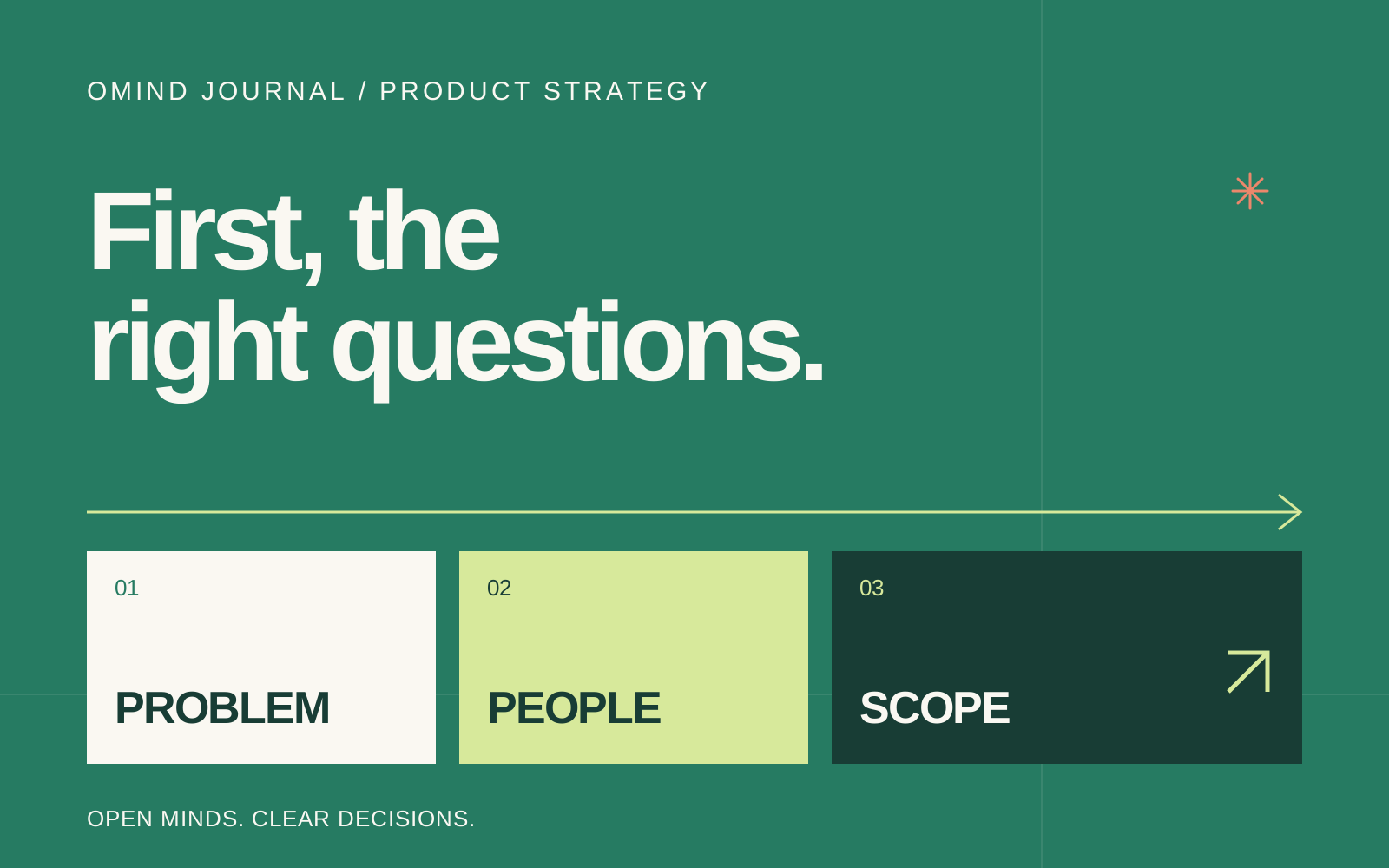
A software project often starts with a feature list: dashboards, reports, approvals, and notifications. The list is useful, but it does not answer the most important question: whose work needs to become easier, and what is getting in the way? Before discussing technology or visual design, the team needs a shared understanding of the problem.
An initial requirements document does not need to be long. It should help business owners, users, and developers make consistent decisions. The following approach gives a custom software discussion a practical starting point.
Start with one real workflow
Choose a process you can describe from beginning to end. For example, an operations employee submits a purchase request, a department head reviews it, and finance processes the payment. Record the participants, incoming information, decisions at each stage, and final outcome. Include the tools currently involved, whether they are spreadsheets, chat messages, or printed documents.
Do not document only the ideal path. Describe what happens when a request is rejected, an attachment is missing, an approver is unavailable, or information needs correcting. These situations often determine whether the application actually supports everyday work.
Separate the problem, the need, and the proposed solution
“We need a dashboard” is a proposed solution. The underlying problem might be that managers cannot identify stalled requests. The need is visibility into each request’s status and owner. A status page, an email summary, or a dashboard could meet that need, depending on how the team works.
For each requirement, complete this sentence: “As a [role], I need [capability], so that [work outcome].” Then add example data and the conditions for success. This helps the team evaluate a need without committing too early to a particular interface.
Define a complete first version
The first version should complete a usable sequence of work, rather than assemble unrelated screens. If purchase requests are the focus, users should be able to create, review, correct, and close requests according to their roles. Advanced reporting can be considered once that basic workflow is clear.
- Essential: capabilities required to complete the main workflow.
- Later: conveniences with a workable temporary alternative.
- Out of scope: requirements deliberately excluded from this stage.
Document assumptions as well. Does the company already have reliable employee records? Will a payment integration provide a test environment? Unverified assumptions should become discovery tasks, rather than quietly being treated as completed work.
Turn expectations into acceptance criteria
“The system must be easy to use” is difficult to assess together. Clearer criteria describe expected behavior: employees see only requests from their unit; amounts above an approval threshold go to the designated role; returned requests display the reason for correction.
Write acceptance examples as a condition, an action, and an outcome. “When a mandatory attachment is missing and the user submits the request, the system identifies the missing document and preserves previously entered information.” This example can guide design, development, and testing.
Discuss data and operations early
Identify who may view, edit, export, and delete information. Discuss legacy records, service account ownership, backups, and support after launch. If other systems are involved, identify the authoritative data source and the people responsible for providing access.
These conversations do not need to produce a complete technical architecture immediately. Their purpose is to surface scope decisions before the team estimates a delivery schedule and budget. For example, migrating inconsistent spreadsheets is different work from importing a clean, agreed data set.
Invite the people who perform the process daily to review these notes. Decision owners understand business goals, while users know operational exceptions. Record and resolve disagreements before treating the requirements as final.
Bring a brief that supports decisions
- The main problem and the user roles affected.
- The current workflow, with example documents or records.
- The first version’s scope and deliberately deferred work.
- Acceptance criteria for the most important journeys.
- Integrations, constraints, and unanswered questions.
- The decision owner and the process for approving changes.
A clear brief can still evolve. The important part is discussing changes alongside their effect on other work. Review our development services and examples of project scopes to prepare the context. Once your workflow begins to take shape, talk to OmindTech about the next practical step.
Join the conversation.
Read reader responses, ask a question, or share your experience.
Keep exploring.
All articles
Technology
Software Houses in the AI Era: Relevant or Replaced?
Amidst the deafening roar of the AI revolution, a crucial question arises: will the role of software houses be eroded? At OmindTech, we understand this concern. This article will guide you through how artificial intelligence, far from being a threat, is actually opening a new chapter for software houses, allowing them to transform into indispensable strategic partners. Let's dive deeper into this shift and uncover the true value that human expertise firmly holds amidst a sea of AI-generated code.

Technology
Programmers in the AI Era: Collaborators or Replacements?
The rise of Artificial Intelligence sparks a big question: will the role of programmers diminish? At OmindTech, we see this not as a threat, but an evolution. AI actually opens new opportunities, transforming programmers from mere code writers into innovative solution architects shaping the future of technology.

Business Systems
Orkesa.id: Business Transformation with OmindTech's Integrated System
Imagine an orchestra where every instrument plays in perfect harmony, creating a beautiful symphony. That's how Orkesa.id works for your business. At OmindTech, we understand that managing various operational aspects – from finance to customer interactions – can be a significant challenge. Orkesa.id emerges as a digital conductor, unifying ERP, CRM, sales automation, and even chatbots, transforming chaos into a symphony of efficiency and growth.
LET’S WORK TOGETHER
Start with your story.
One conversation can open up a new perspective. Tell us about your challenge.