
Technology / OmindTech Journal
Best Programming Language: Myth or Reality? Choosing the Right One for Your Needs
Searching for the best programming language is a futile endeavor. This article explains why there is no universally 'best' programming language and how to choose the most suitable one for your project.

Best Programming Language: Myth or Reality? Choosing the Right One for Your Needs
The question of the best programming language is one of the most common in the world of software development. Unfortunately, there is no simple answer. There is no universally "best" programming language. Instead, there is a programming language that is most suitable for a specific task or project. This is an important concept that every developer, whether beginner or experienced, needs to understand.
In this article, we will discuss why the idea of a "best" programming language is a myth, the factors to consider when choosing a programming language, and some case examples where a particular language excels.
Why There Is No Best Programming Language?
The concept of "best" is highly subjective and context-dependent. A programming language ideal for building web applications might be very inefficient for developing embedded systems. Here are some reasons why no programming language can be considered universally "best":
Diverse Use Cases: Software is used in various industries and for various purposes. From web and mobile application development to data science, artificial intelligence, and operating systems, each domain has unique requirements and constraints. A language that excels in one domain may be lacking in another.
Technological Evolution: The technological landscape is constantly evolving. New languages emerge, and existing ones are continually updated and improved. A language popular today might become obsolete in a few years. Therefore, it is important to choose a language that is continuously developed and supported by an active community.
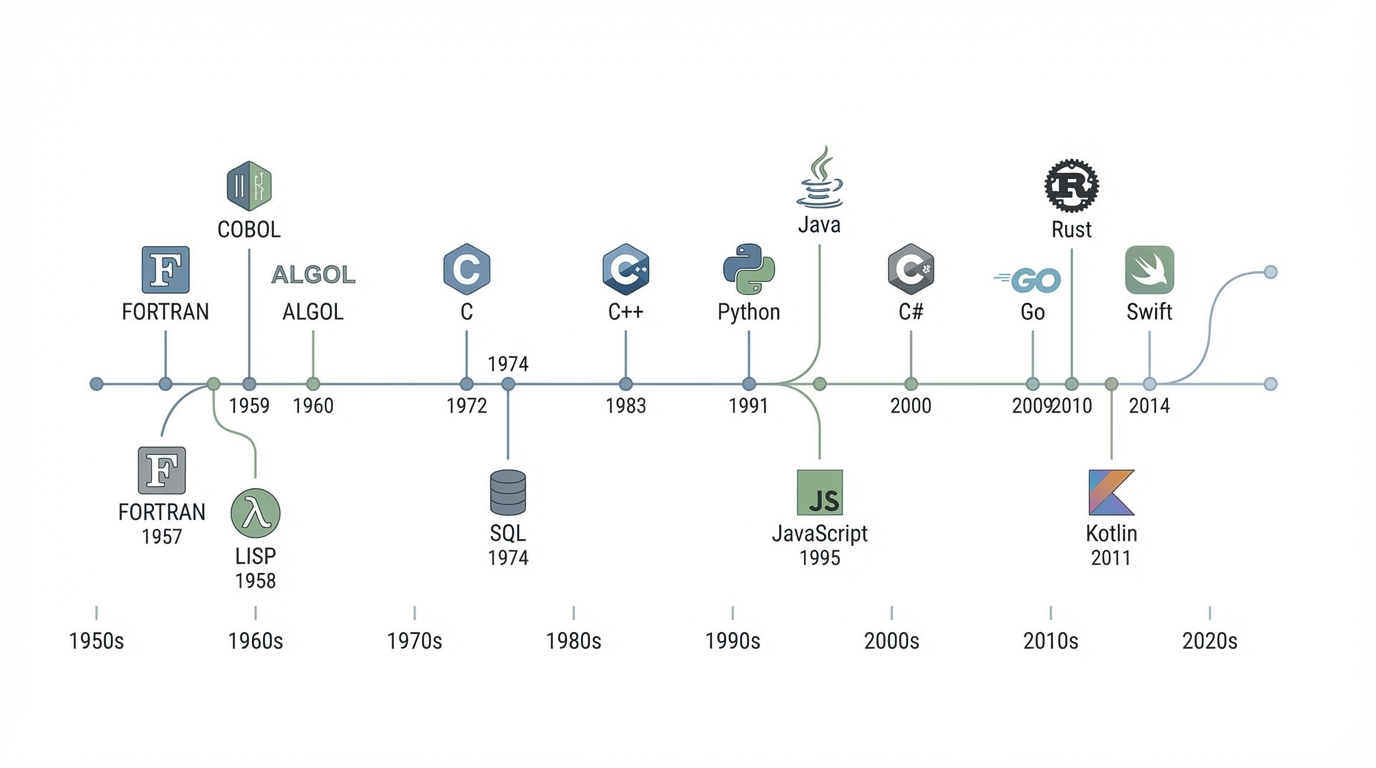
Personal and Team Preferences: Developers' experience, skills, and personal preferences play a significant role in language selection. A team already proficient in a particular language may be more productive using that language rather than learning a new one.
Performance: The performance of programming languages varies greatly, depending on the efficiency of the compiler or interpreter implementation, as well as optimizations made by developers. Some languages are optimized for speed, while others focus more on ease of development.
"At OmindTech, we often emphasize that programming language choice should be based on project needs, not just trends or personal preferences. A deep understanding of each language's strengths and weaknesses is key to making the right decision."
Factors to Consider When Choosing a Programming Language
When choosing a programming language for your project, consider the following factors:
Project Type: Are you building a web application, a mobile application, a game, or an embedded system? Some languages are more suitable for certain project types than others.
Performance: How important is performance for your project? If you are building an application that requires high performance, you may need to choose a language optimized for speed.
Scalability: How much will your application grow in the future? If you anticipate significant growth, you need to choose a language that supports scalability.
Availability of Libraries and Frameworks: Are there libraries and frameworks available for the language you are considering that can help you accelerate development?
Community: How large and active is the community for the language you are considering? A large and active community can provide support, tutorials, and other resources.
Learning Curve: How easy is the language you are considering to learn? If you have tight deadlines, you may need to choose a language that is easier to learn.
Cost: Some programming languages are open-source and free to use. Meanwhile, some other languages require licensing fees. Consider your project budget when making a decision.
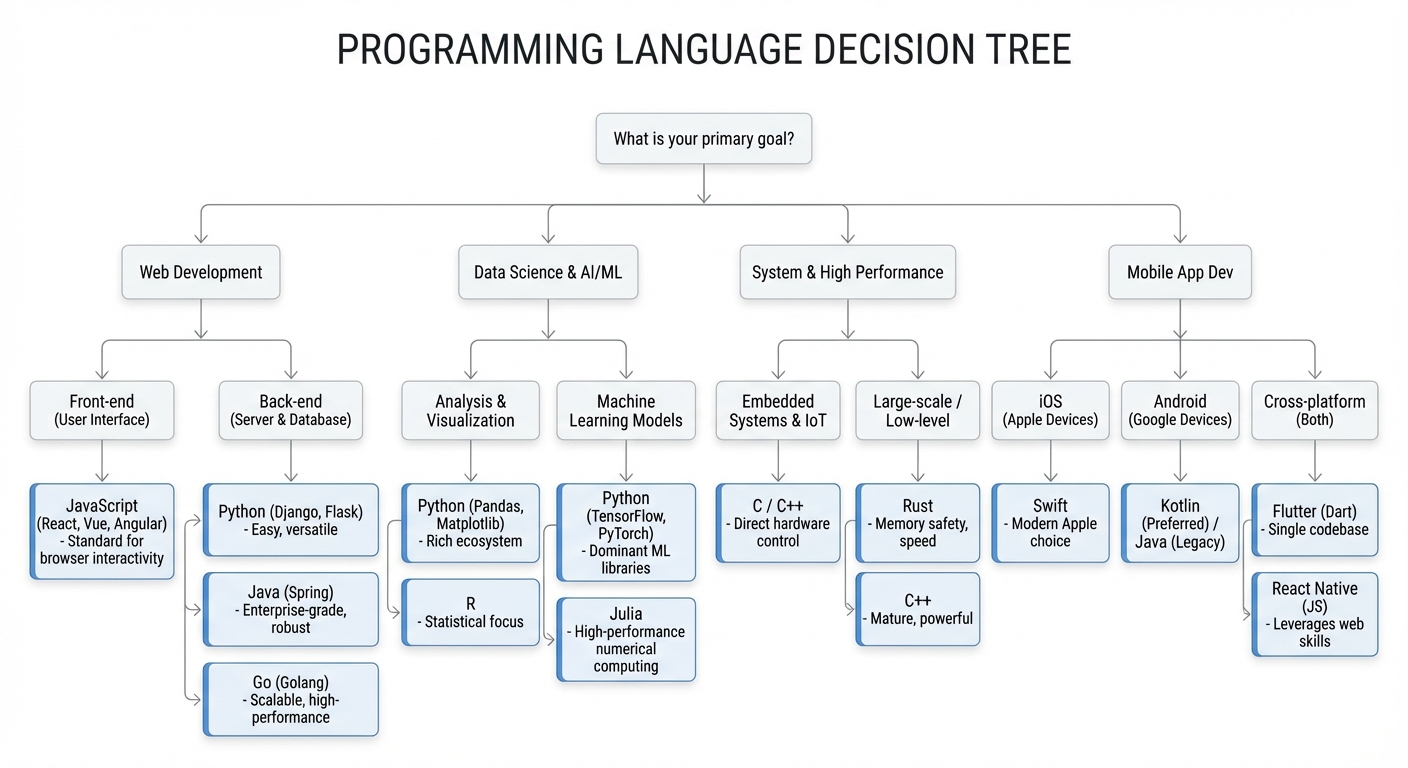
Case Examples: When Does a Specific Language Excel?
Let's look at some case examples where a particular language excels:
Frontend Web Development: JavaScript is the de facto language for frontend web development. With frameworks like React, Angular, and Vue.js, JavaScript allows developers to build interactive and dynamic user interfaces.
Backend Web Development: There are many options for backend web development, including Python (with frameworks like Django and Flask), Java (with Spring), Node.js (JavaScript on the server side), Ruby (with Ruby on Rails), and PHP (with Laravel).
Mobile Application Development: Kotlin is the language of choice for Android application development. Swift is used for iOS application development. Additionally, cross-platform frameworks like React Native and Flutter allow developers to build mobile applications that can run on both Android and iOS using a single codebase.
Data Science and Machine Learning: Python is the dominant language in data science and machine learning. With libraries like NumPy, Pandas, Scikit-learn, and TensorFlow, Python provides powerful tools for data analysis, visualization, and machine learning model development.
Game Development: C++ is often used in game development due to its high performance and control over hardware. C# (with Unity) is also a popular choice for game development.
Embedded Systems: C and C++ are commonly used languages in embedded system development due to their efficiency and ability to interact directly with hardware.
Choosing What's Most Suitable, Not What's Best
Remember, the main goal is to choose the language that is most suitable for your project's specific needs. This means conducting research, considering the factors we have discussed, and perhaps experimenting with several different languages before making a final decision.
Don't get caught up in "which is better" debates about which programming language is "best." Focus on choosing the right tool for the job, and you will be more likely to succeed in your software development project.
Conclusion
There is no universally "best" programming language. The right choice of language depends on various factors, including project type, performance requirements, scalability, availability of libraries and frameworks, team size and skills, and budget. By considering these factors and conducting research, you can make an informed decision and choose the language that is most suitable for your needs.
In our experience at OmindTech, understanding the nuances of each language and their respective strengths and weaknesses is paramount. We encourage developers to broaden their skillset and become proficient in multiple languages to be more adaptable to diverse project requirements. This adaptability is key to success in the ever-evolving world of software development.
Join the conversation.
Read reader responses, ask a question, or share your experience.
Keep exploring.
All articles
Technology
Integrated Financial Apps: The Key to Business Scalability
Discover how integrated financial applications and custom accounting software can slash reconciliation times by 80% and drive limitless business growth.

Technology
Beyond Hype: 3 Tech Trends 2026 Reshaping Indonesian Business
2026 marks the shift from AI experimentation to real-world deployment. From Agentic AI to PDP-compliant data sovereignty, discover how business infrastructure in Indonesia is evolving from passive to autonomous.

Technology
Beyond New Computers: Digitalizing Schools for Indonesia 2045
Why is a stack of computers in a school lab never enough? We dissect the harsh reality of digital transformation in Indonesian education and how ecosystem-driven digitalization can foster world-class talents for Golden Indonesia 2045.
LET’S WORK TOGETHER
Start with your story.
One conversation can open up a new perspective. Tell us about your challenge.