
Business / OmindTech Journal
Why Indonesia's Startup Ecosystem is Slowing Down: Solutions
An in-depth analysis of Indonesia's Tech Winter, exploring the fall of cash-burning startups, valuation corrections, and the strategic pivot toward sustainable profitability.

Table of Contents
- Introduction: Understanding the Reality of 'Tech Winter' in Indonesia
- Valid Data & Ground Facts: Funding Declines and Valuation Corrections of Giants
- The Root Causes: Failure of the 'Cash-Burning' Model and Governance Risks
- Investor Paradigm Shift: Why e-Fishery-Style Efficiency is the New Benchmark
- Strategic Steps for Startups: Focusing on Unit Economics and Governance
- The Crucial Role of Government: Pro-Innovation Regulation and Digital Infrastructure
- A New Direction for Indonesia's Digital Ecosystem Through a Healthy Consolidation Phase
Key Takeaways:
- Indonesia's startup ecosystem is currently experiencing a "Tech Winter" triggered by rising global interest rates and a shift in investor focus from aggressive growth to real profitability.
- Tech giants like GoTo (Gojek) and Bukalapak have faced massive valuation corrections post-IPO, forcing radical restructurings.
- Corporate governance issues and fraud risks have come under intense scrutiny, eroding the trust of global investors.
- Sustainable business models deeply rooted in the real sector, such as e-Fishery, have now become the new gold standard for startup success.
- The government must play a proactive role by creating regulations that support local funding and transparent ecosystem protection.
1. Introduction: Understanding the Reality of 'Tech Winter' in Indonesia
Indonesia's digital landscape, once touted as the epicenter of Southeast Asia's digital economy growth, is currently facing its toughest test yet. The era of unlimited funding, skyrocketing valuations, and ubiquitous startup billboards occupying every urban corner has been replaced by a much colder narrative: Tech Winter.
This market correction cycle is not a temporary phenomenon. It is a fundamental restructuring of how digital businesses are built, funded, and operated. At OmindTech, we view this turbulence not as the end of innovation, but as a natural cleansing process. The ecosystem is being forced to separate entities that create genuine, long-term value from those that merely survive on venture capital subsidies.
The slowdown is characterized by a dry-up in late-stage funding, declining appetite for tech IPOs, and a continuous wave of layoffs. To understand where the industry is heading, we must objectively dissect its root causes based on real, verifiable data.
2. Valid Data & Ground Facts: Funding Declines and Valuation Corrections of Giants
Data never lies. The decline in investment activity within Indonesia's tech sector is clearly reflected in various financial market research reports throughout 2023 and into mid-2024.
According to data from Cento Ventures, total venture capital investment in Southeast Asian startups dropped by over 50% year-on-year. Indonesia, which typically attracts the largest share of funding alongside Singapore, took a heavy blow. Seed-to-Series A funding shrank drastically, while mega-rounds (above USD 100 million) practically froze.
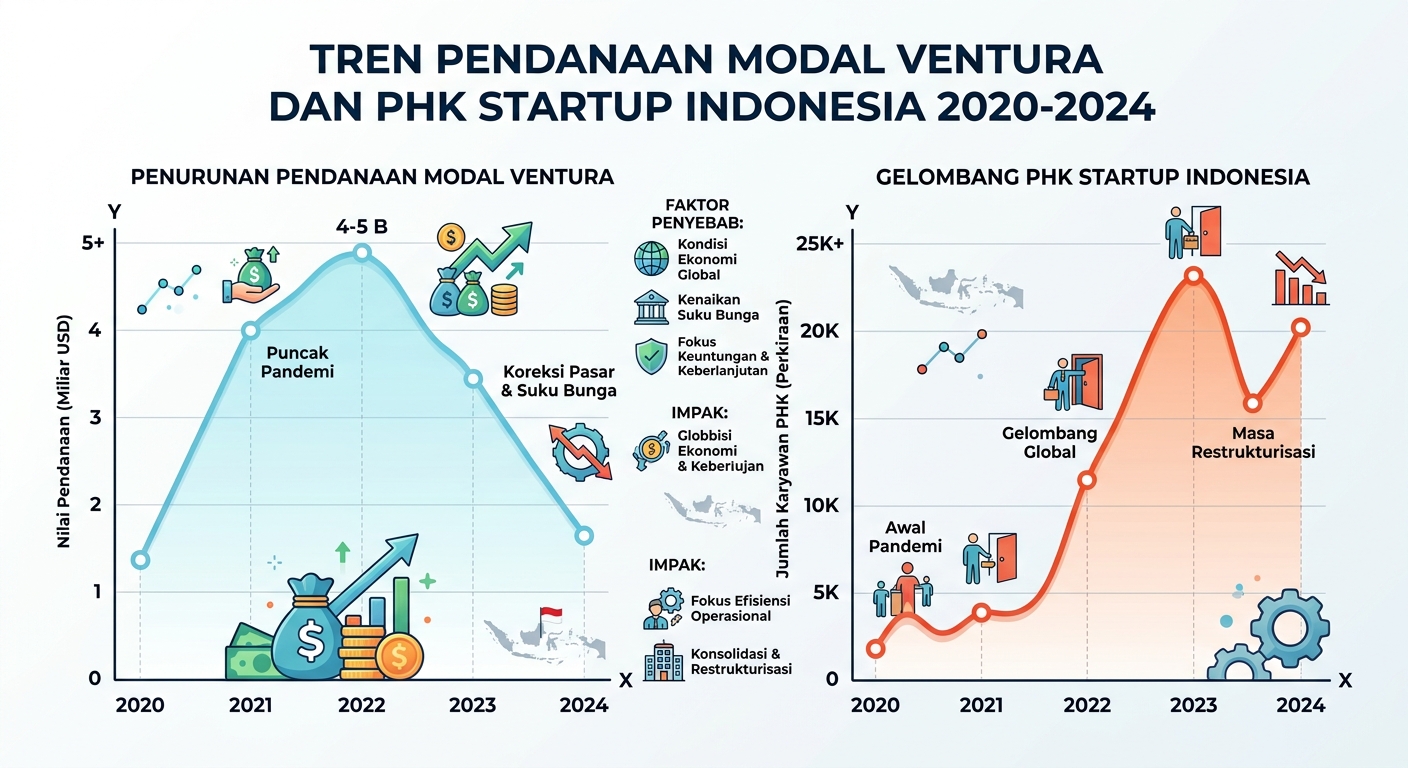
The impact was immediately felt by local tech giants that had successfully gone public:
- GoTo (Gojek Tokopedia): Since its IPO in 2022, GoTo's share price has faced massive selling pressure, occasionally touching all-time lows before stabilizing. This valuation correction reflects public market skepticism over the company's ability to turn massive accounting losses into net profits.
- Bukalapak: Despite holding a very strong cash position from its remaining IPO proceeds, Bukalapak has had to work hard to redefine its core business model. Slower growth in its O2O (online-to-offline) business line has forced management to implement tight cost-efficiencies and strategic pivots to maintain shareholder confidence.
The market capitalization corrections of these tech pioneers sent a clear signal down the startup food chain: if tech giants with millions of users struggle to maintain their valuations, mid-sized and early-stage startups must immediately change their survival strategies.
3. The Root Causes: Failure of the 'Cash-Burning' Model and Governance Risks
Why did this situation occur? There are three main internal factors driving the collapse of startup foundations in the country.
Failure of the "Cash-Burning" (Growth at All Costs) Business Model
For nearly a decade, a startup's success was measured by its Gross Merchandise Volume (GMV) and Monthly Active Users (MAUs). In chasing these metrics, startups fell into a vicious cycle of user acquisition driven by discounts, shipping subsidies, and aggressive promos. When global liquidity dried up due to interest rate hikes by central banks (such as the Federal Reserve), the venture capital tap was turned off. Startups without positive unit economics quickly ran out of runway as they couldn't fund their own operations.
Lack of Real Profitability
Many startups were built on the assumption that profitability would naturally follow once scale was achieved. In reality, user loyalty built on subsidies is highly fragile. Once the subsidies are withdrawn, users quickly switch to competitors or return to conventional methods. Businesses without a strong protective moat crumbled overnight.
Weak Corporate Governance and Fraud Risks
A factor often omitted from public discourse but heavily scrutinized by investors is weak Corporate Governance. The lack of independent board oversight combined with unchecked founder ambitions led to budget waste and instances of financial misconduct (fraud). Scandals involving fabricated financial statements and inflated performance metrics at several regional startups have systematically damaged the reputation of Indonesia's startup ecosystem in the eyes of global investors.
4. Investor Paradigm Shift: Why e-Fishery-Style Efficiency is the New Benchmark
The era of chasing expensive Unicorn status is over. Global investors are no longer impressed by prestigious titles unless they are backed by sound financial fundamentals. The investment focus has shifted from "How fast can you grow?" to "How fast can your business generate positive cash flow?"
In this new landscape, e-Fishery has emerged as a highly respected role model. The Bandung-based agritech startup successfully achieved unicorn status without relying on market-distorting cash-burning schemes.
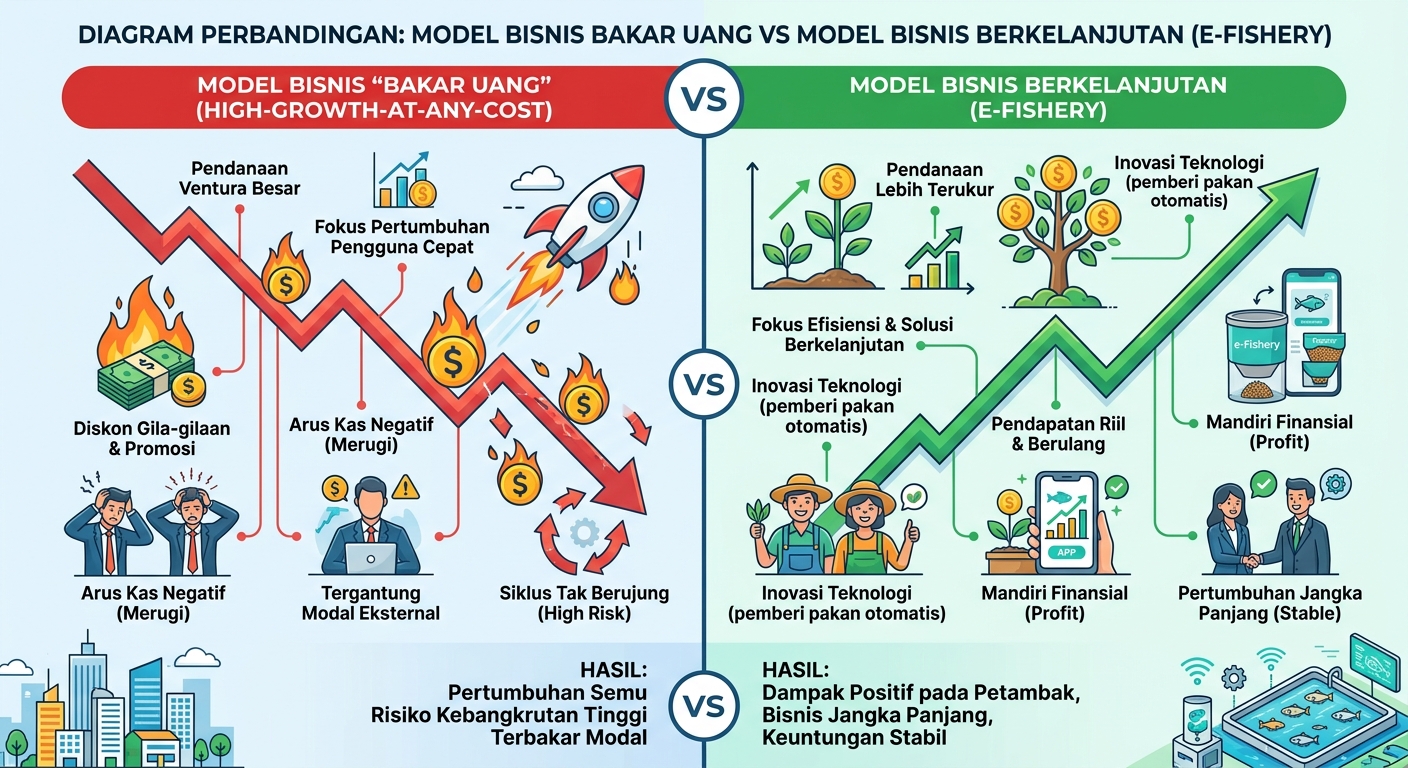
The key to e-Fishery's success lies in its ability to integrate digital technology into a very real physical supply chain (fish and shrimp farmers). They solve actual pain points in the real sector:
- Feeding Efficiency: Their smart automated feeder (auto-feeder) significantly reduces the largest cost component for farmers.
- Market & Financing Access: Directly connecting farmers to corporate buyers and trusted financial institutions.
- Positive Unit Economics: Every transaction and service rendered has a clear profit margin from day one.
The success of e-Fishery proves that technology combined with a deep understanding of Indonesia's real economy is far more valuable than pure digital platforms that rely on margin-less virtual transactions.
5. Strategic Steps for Startups: Focusing on Unit Economics and Governance
For startups wishing to survive and thrive through this transition, the OmindTech team has summarized three strategic steps that must be implemented:
A. Improve Unit Economics
Every unit of product or service sold must generate a positive contribution margin after accounting for Customer Acquisition Cost (CAC) and Customer Lifetime Value (LTV). If acquiring a new customer costs more than the profit that customer generates over their lifetime, the business model is fundamentally broken.
B. Optimize Operational Efficiency Through the Right Technology
Instead of hyper-hiring—which often leads to severe organizational redundancies and inefficiencies—startups must optimize their use of technology. Implementing process automation, targeting AI adoption where it matters, and building robust yet cost-effective software architectures are key to keeping operational expenses down.
C. Enforce Good Corporate Governance (GCG)
Financial transparency, regular audits, and leadership accountability are non-negotiable. Startups must treat investor capital with absolute responsibility, ensuring that every rupiah spent directly contributes to long-term business value creation.
6. The Crucial Role of Government: Pro-Innovation Regulation and Digital Infrastructure
The government cannot stand by and watch the ecosystem slow down. Well-calibrated interventions from regulators can serve as a catalyst for the revival of the national technology industry.
Balanced, Pro-Innovation Regulations
The government needs to create a stable legal environment that fosters new business models without stifling innovation. Regulations regarding personal data protection (UU PDP), cybersecurity, and consumer protection must be fairly enforced to build market trust.
Domestic Funding Incentives
A heavy reliance on foreign venture capital makes Indonesian startups highly vulnerable to global macroeconomic shocks. The government can encourage domestic financial institutions—such as pension funds, insurance companies, and state-owned enterprises—to allocate a portion of their investment portfolios to the local tech sector through professionally managed fund-of-funds structures.
Strengthening Digital Infrastructure Outside Java
Equal digital access is key to expanding markets for local startups. Building high-speed internet networks, increasing digital literacy in Tier-2 and Tier-3 cities, and streamlining business permits will unlock untapped economic potential across the archipelago.
7. A New Direction for Indonesia's Digital Ecosystem Through a Healthy Consolidation Phase
The current slowdown or Tech Winter we are experiencing is not a sign of total failure for Indonesia's digital economy. Rather, it is a much-needed consolidation phase to cleanse the market of excess speculation and unsustainable business practices.
As the cold fog begins to lift, we will see a far more mature, resilient, and value-driven ecosystem. The future startups of Indonesia will no longer be judged by their paper valuations, but by the tangible impact they deliver to industrial efficiency and the well-being of society.
As a premium technology development partner, OmindTech remains committed to supporting industry players in building reliable, efficient software foundations that are ready to face dynamic global challenges. Indonesia's digital journey is far from over, and a healthier, more sustainable chapter has just begun.
Join the conversation.
Read reader responses, ask a question, or share your experience.
Keep exploring.
All articles
Business
Business Step Up Guide: From Bootstrapping to Scale Up
The journey from bootstrapping to scaling up is filled with fatal traps. Discover how the right technology serves as the ultimate catalyst for a successful and sustainable 'Business Step Up'.

Technology
Software Houses in the AI Era: Relevant or Replaced?
Amidst the deafening roar of the AI revolution, a crucial question arises: will the role of software houses be eroded? At OmindTech, we understand this concern. This article will guide you through how artificial intelligence, far from being a threat, is actually opening a new chapter for software houses, allowing them to transform into indispensable strategic partners. Let's dive deeper into this shift and uncover the true value that human expertise firmly holds amidst a sea of AI-generated code.

Technology
Programmers in the AI Era: Collaborators or Replacements?
The rise of Artificial Intelligence sparks a big question: will the role of programmers diminish? At OmindTech, we see this not as a threat, but an evolution. AI actually opens new opportunities, transforming programmers from mere code writers into innovative solution architects shaping the future of technology.
LET’S WORK TOGETHER
Start with your story.
One conversation can open up a new perspective. Tell us about your challenge.