
Technology / OmindTech Journal
The AI Battle: China vs. America - Who Leads and How Is China Catching Up?
The United States and China are in a fierce competition for AI development. This article reviews their differing approaches, strengths, and China's efforts to catch up in artificial intelligence.

The Future Tech Battle: AI from China vs. America
The competition between the United States and China in artificial intelligence (AI) is heating up. These two superpowers are vying to become leaders in this transformative technology. However, each nation's approach, strengths, and weaknesses vary significantly. This article will delve into a deep comparison of AI developed in China and America, as well as China's efforts to catch up.
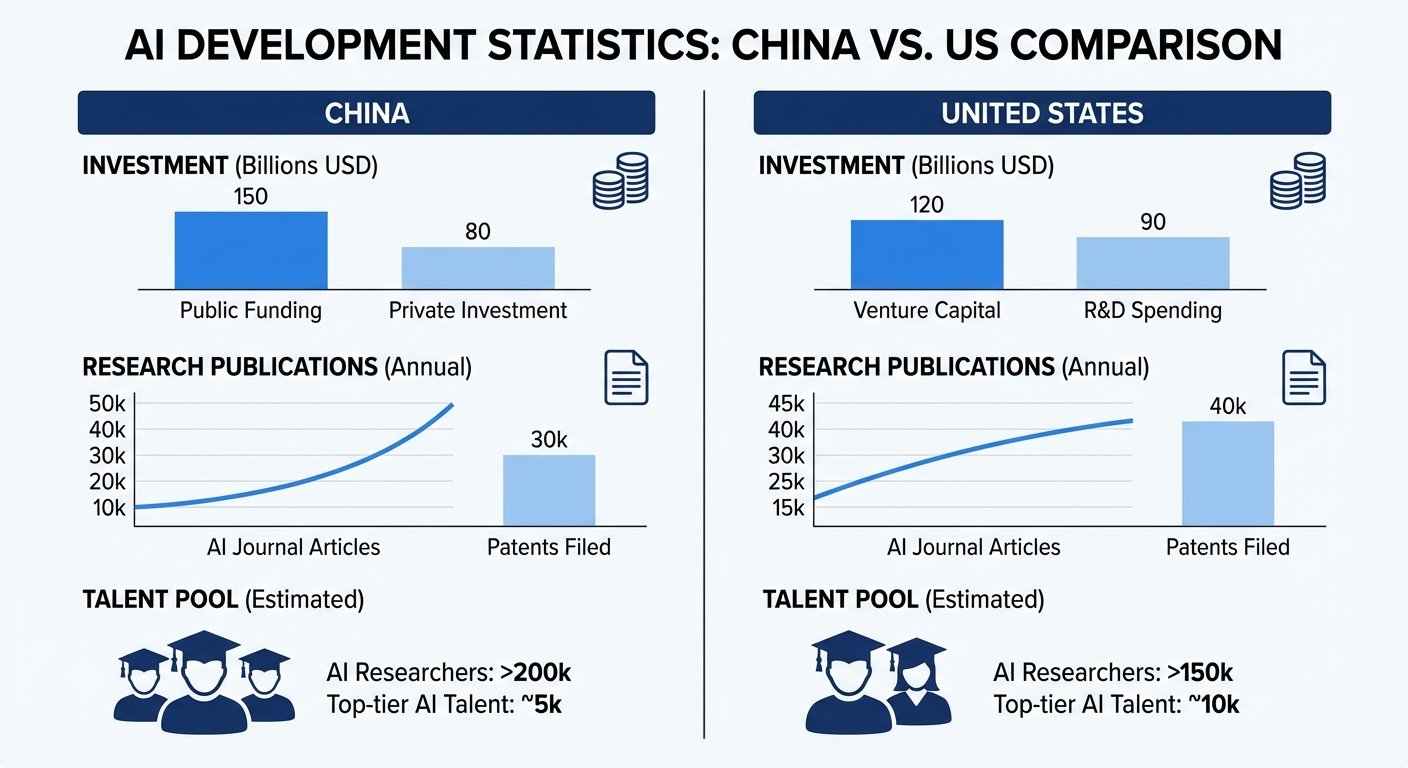
Different Approaches
United States:
- Private Sector-Driven Innovation: In the United States, AI development is largely driven by private companies such as OpenAI (with ChatGPT), Google (with Gemini), and Anthropic (with Claude). These companies invest heavily in research and development and are often at the forefront of innovation.
- Focus on Large Language Models (LLMs): American companies are heavily focused on developing advanced LLMs. They use vast datasets and complex neural network architectures to train models capable of generating text, translating languages, writing various creative content types, and answering questions informatively.
- More Flexible Regulation: Regulation in the United States tends to be more flexible compared to China. This gives AI companies more freedom to experiment and innovate but also raises concerns about AI ethics and security.
China:
- Strong Government Support: The Chinese government plays a very significant role in AI development. The government provides substantial financial support, sets ambitious targets, and encourages collaboration among universities, research institutions, and private companies.
- Focus on Practical Applications: China has a strong focus on applying AI in various sectors, including manufacturing, healthcare, transportation, and public security. They aim to leverage AI to improve efficiency, productivity, and quality of life.
- Abundant Data: China has a very large population and widespread internet usage. This generates vast amounts of data, which fuels AI development. Chinese companies have access to more data than American companies, allowing them to train more powerful AI models.
- Stricter Regulation: Regulation in China is stricter compared to the United States. The Chinese government aims to control the development and use of AI to ensure that the technology is used for positive purposes and does not endanger national security or social stability.
Strengths and Weaknesses
United States:
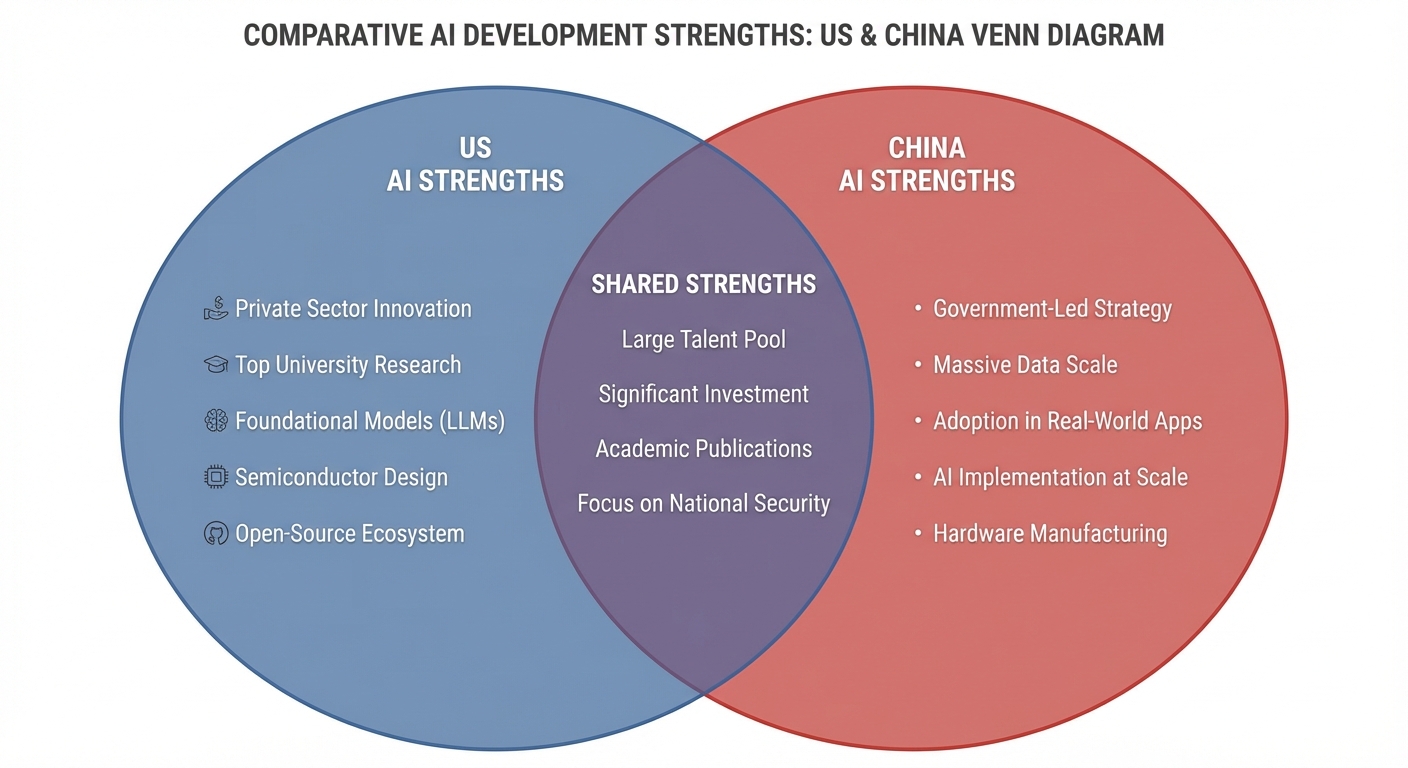
- Strengths: Innovation, advanced LLMs, strong startup ecosystem, world's top talent.
- Weaknesses: Less clear regulation, ethical concerns, reliance on data from other sources.
China:
- Strengths: Government support, abundant data, focus on practical applications, rapid implementation.
- Weaknesses: Reliance on imported technology, less original innovation, strict regulation.
How China Is Catching Up
China recognizes that it lags behind the United States in several AI areas, particularly in developing advanced LLMs. However, China has taken significant steps to catch up, including:
- Massive Investment in Research and Development: The Chinese government has invested billions of dollars in AI research and development. These investments help fund research projects in universities and research institutions, as well as support the development of AI companies.
- Recruiting Top Talent: China is striving to attract the best AI talent from around the world. The government offers attractive financial incentives and facilities to encourage AI scientists and engineers to work in China.
- Building a Strong AI Ecosystem: China is working to build a robust AI ecosystem by connecting universities, research institutions, private companies, and the government. This ecosystem facilitates collaboration and knowledge sharing, which helps accelerate innovation.
- Focus on Industrial Applications: China focuses on applying AI in various industrial sectors. This helps generate valuable data and develop AI models tailored to specific needs.
One concrete example is the rapid development of companies like Baidu, Alibaba, Tencent, and Huawei in the AI sector. They are developing various AI solutions for both domestic and international markets. Furthermore, the emergence of AI unicorns like SenseTime and Megvii demonstrates significant innovation potential in China.
In our experience at OmindTech, we've observed a growing interest in Chinese AI solutions, particularly in areas like facial recognition and computer vision. This is driving further innovation and competition.
The Future of AI Competition
The competition between the United States and China in AI is expected to intensify in the future. Both nations will continue to invest in research and development, recruit top talent, and build strong AI ecosystems.
Who will lead in AI technology? It is difficult to say for sure. The United States holds an advantage in innovation and LLMs, while China excels in data, government support, and practical applications. Most likely, both countries will continue to compete and collaborate in AI, and this rivalry will drive innovation and progress worldwide.
However, it is important to remember that AI development also poses challenges and risks. It is crucial to ensure that AI is used ethically and responsibly, and that its benefits are distributed equitably to everyone. Effective regulation and international collaboration will be vital to address these challenges.
Concrete Example: DeepSeek vs. OpenAI
As an example, let's compare DeepSeek, an AI model developed in China, with OpenAI, the company behind ChatGPT. DeepSeek has shown significant progress in recent years and can compete with OpenAI's models in several tasks. However, OpenAI still leads in terms of generalization capabilities and deep natural language understanding. This competition drives both companies to continuously innovate and develop better AI models.
Conclusion
The competition between AI from China and America is one of the most significant technological rivalries of the 21st century. Both nations have different approaches, strengths, and weaknesses. China is working hard to catch up, and this competition will drive innovation and progress worldwide. The future of AI will be shaped by how these two countries compete and collaborate.
Join the conversation.
Read reader responses, ask a question, or share your experience.
Keep exploring.
All articles
Technology
Integrated Financial Apps: The Key to Business Scalability
Discover how integrated financial applications and custom accounting software can slash reconciliation times by 80% and drive limitless business growth.

Technology
Beyond Hype: 3 Tech Trends 2026 Reshaping Indonesian Business
2026 marks the shift from AI experimentation to real-world deployment. From Agentic AI to PDP-compliant data sovereignty, discover how business infrastructure in Indonesia is evolving from passive to autonomous.

Technology
Beyond New Computers: Digitalizing Schools for Indonesia 2045
Why is a stack of computers in a school lab never enough? We dissect the harsh reality of digital transformation in Indonesian education and how ecosystem-driven digitalization can foster world-class talents for Golden Indonesia 2045.
LET’S WORK TOGETHER
Start with your story.
One conversation can open up a new perspective. Tell us about your challenge.